Dear coachingspace community,
we are often asked which other methods we have planned for our virtual consulting room. As already hinted, these of course include the methods of our cooperation partner, the Schulz von Thun Institute, such as the new version of the Inner Team and the values square. Several more methods are already in planning and partly already in development, but may not be revealed here yet. One very frequently requested method is the timeline. That is why it sits quite high on our list. However, thanks to our community member and colleague Egbert Schuwardt (visit his website), we recently learned that a variant of the timeline can already be implemented wonderfully with our online constellation board.
So below we happily hand over to Egbert himself, and wish you much fun trying out his timeline variant.
Your coachingspace team
The online constellation board for implementing a timeline variant: an idea by Egbert Schuwardt
Hello dear community,
I am first and foremost a mediator, and I love using the timeline as an effective tool. So it was my declared goal to find a digital equivalent.
In the mediation room, I normally mark the starting point with a rope, and if needed the point in the future or in the past. Unlike in coaching, I then like to use the view onto a goal already reached. Klaus Theuretzbacher and Peter Nemetschek (Coaching und Systemische Supervision mit Herz, Hand und Verstand) call this point "already able to smile about it…".
The in-person version
How exactly do I proceed in person? "Let's assume the mediation has ended successfully. When do you think that will be?" – "At the end of the year!" – "Great, then let's place ourselves on 31 December 2021 together. We have a glass of sparkling wine in hand to toast what we have achieved and the year drawing to a close. We started the mediation in May 2021. Back then in May, what was the first important step towards the mediation that ended successfully today?"
It is important that the parties perceive New Year's Eve 2021 as the present moment and remember back over all the steps they took to arrive at this day.
In person, we then lay out cards with measures named by the parties at the important points in time. Once all necessary cards are laid out, I return with the parties to the starting point of May 2021 and walk the timeline together. As we do, I ask the parties whether these are the steps to get from the here and now to the moment of "already able to smile about it…". This point is often also called the future perfect.
Through the movement, the laying out and the marking, the parties or clients move from telling into doing, and thus more easily into finding solutions (solution talk instead of problem talk).
My use of the timeline is therefore a method for thinking from the end. My most important practical experience: the parties or clients put themselves into the state of thinking from the "point of smiling" back into the past. It is fascinating to watch how the party then recognizes the individual steps in the past as a much smaller obstacle than when standing in front of the mountain.
For teams, the timeline is also a wonderful way to, for example, develop several variants that can flow into one target variant. The timeline can also be used to travel back to the starting point of a conflict (including inner conflicts). Here the client looks back into the past. Asking which bodily sensation appears (somatic markers) can yield deeper insights into the cause of the conflict. Often the parties then also discover that they do not always perceive the same event as the cause of the conflict.
A variant for online implementation
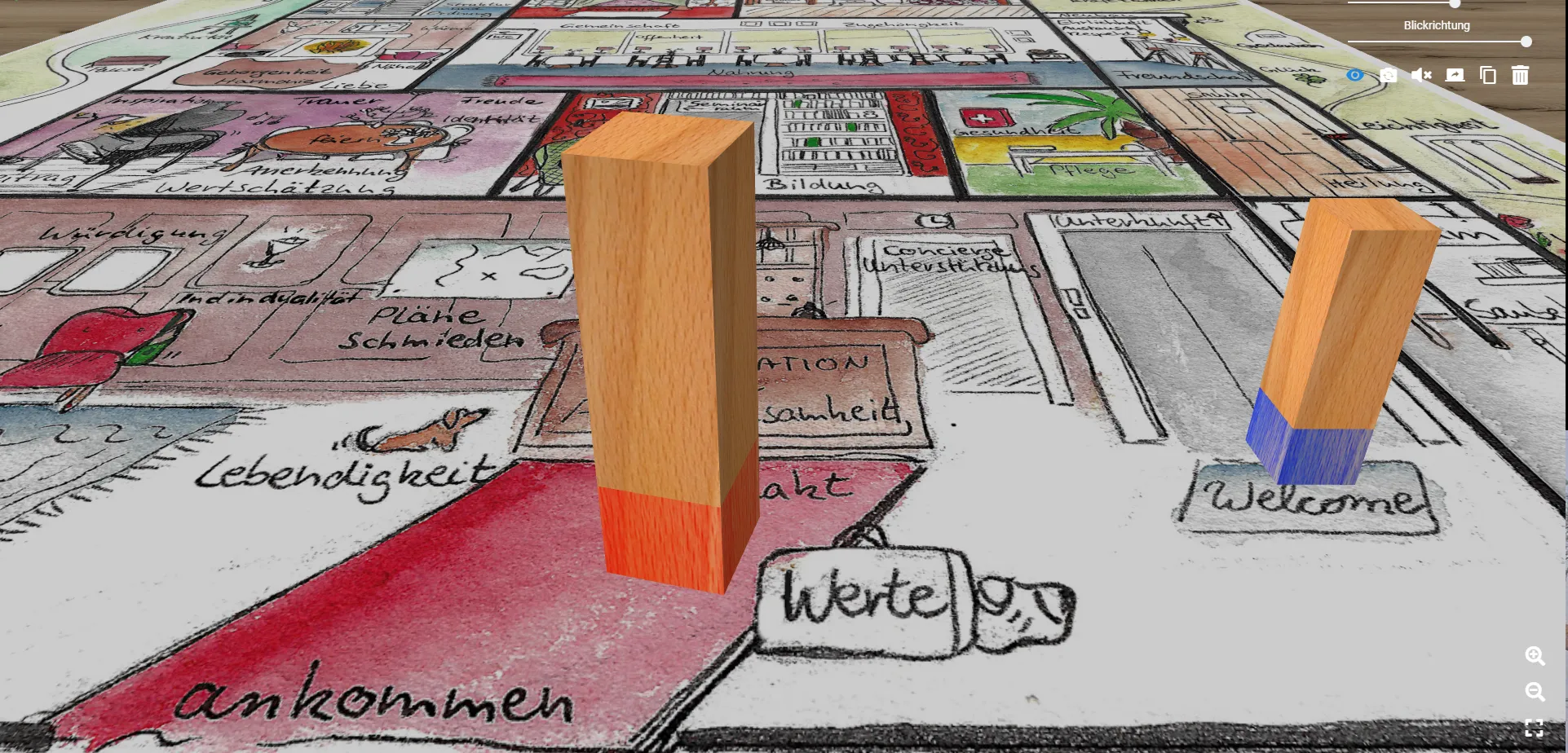
But how could all of this work online? In my experience, it actually does not need many changes. Thanks to the online constellation board in coachingspace, the questions remain the same. Instead of cards, I use the blocks there, for example, to mark different options (see screenshot 1). I set up one figure representing the client in today's situation, and another for the future (in the example, New Year's Eve 2021).
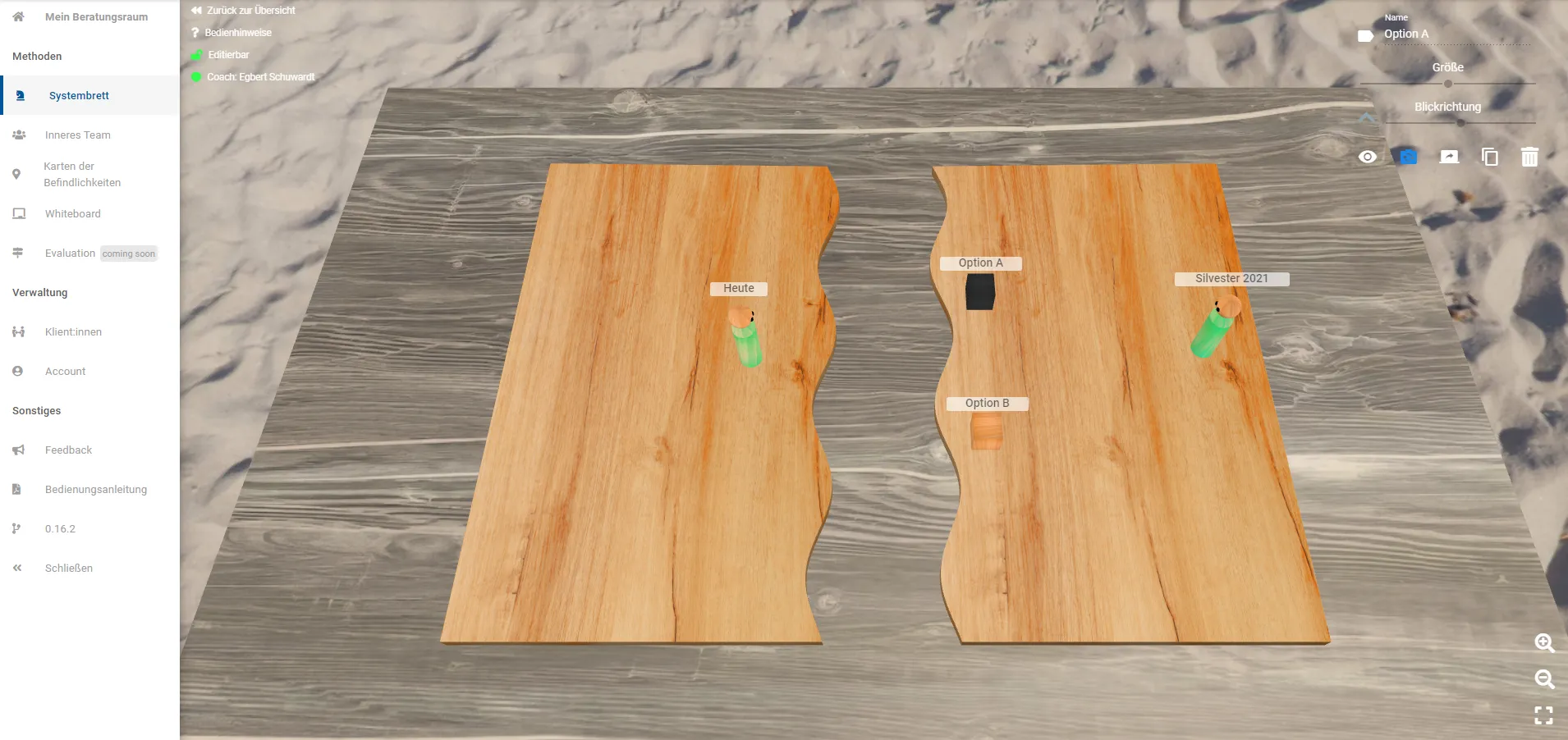
A possible basic setup, for example when a party has to choose between two options
Thanks to the possibility in coachingspace of adjusting the line of sight and taking the inner perspective of individual figures, "thinking from the end" is child's play to implement (see screenshot 2). In the online setting it sometimes takes a little more time than in person to let it sink in. A bit of patience is needed. Then, online as well, we walk the digital timeline from the back and again lay blocks as measures or steps the parties took up to the "point of smiling" (two blocks are included from the start in the colorful figure set; more can be created via the duplicate function).
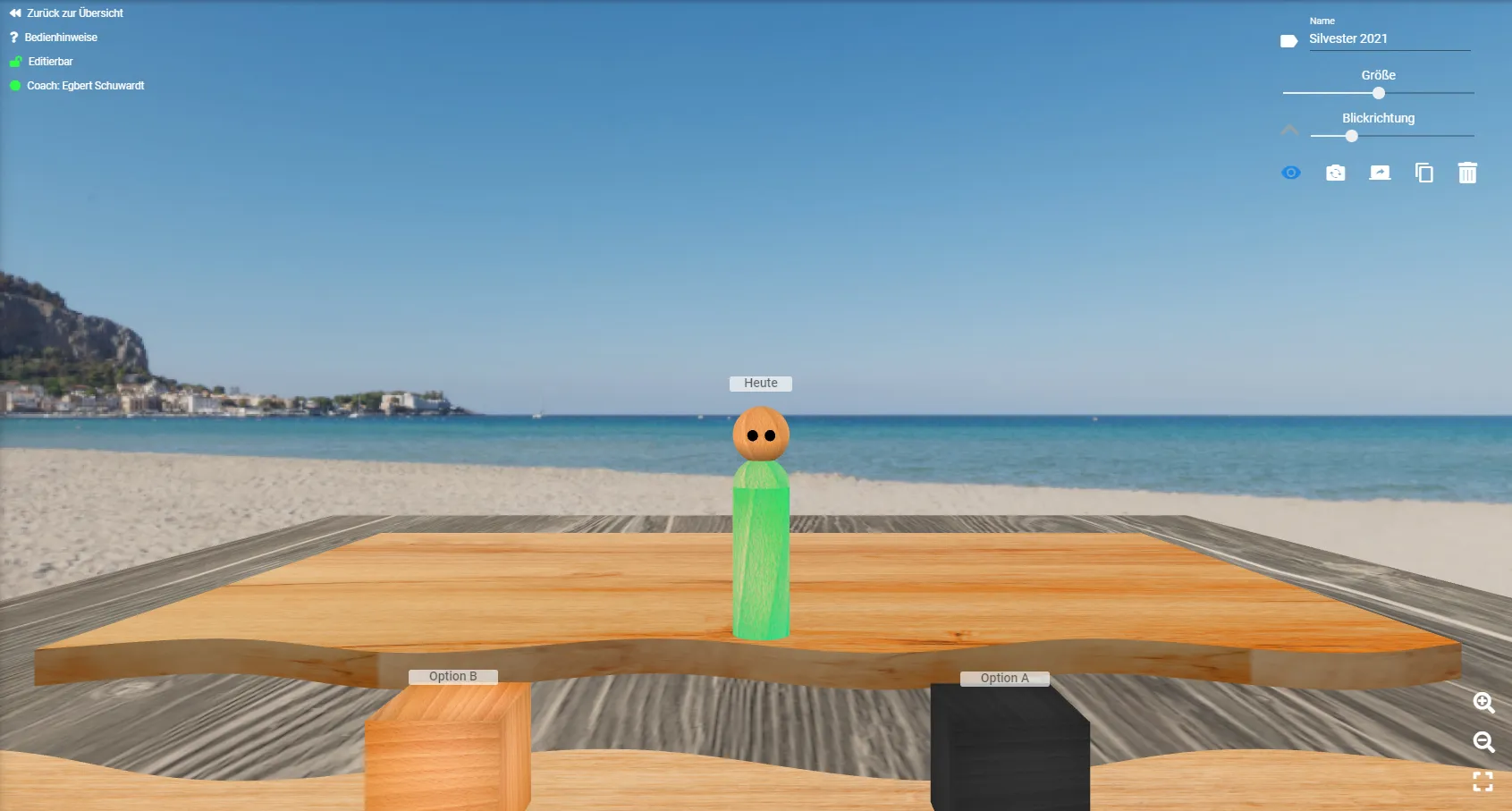
From the inner perspective of the future self, you can feel your way into the "point of smiling" and then walk the timeline from the back, starting there
Sometimes, as in the example shown, I choose the wavy board (sine board), which nicely conveys that this is something in the future. Afterwards, you can ask the parties to push the boards together and ask how close they are to "already able to smile about it…", or to sense while pushing what it takes to get closer to this state (see screenshot 3).
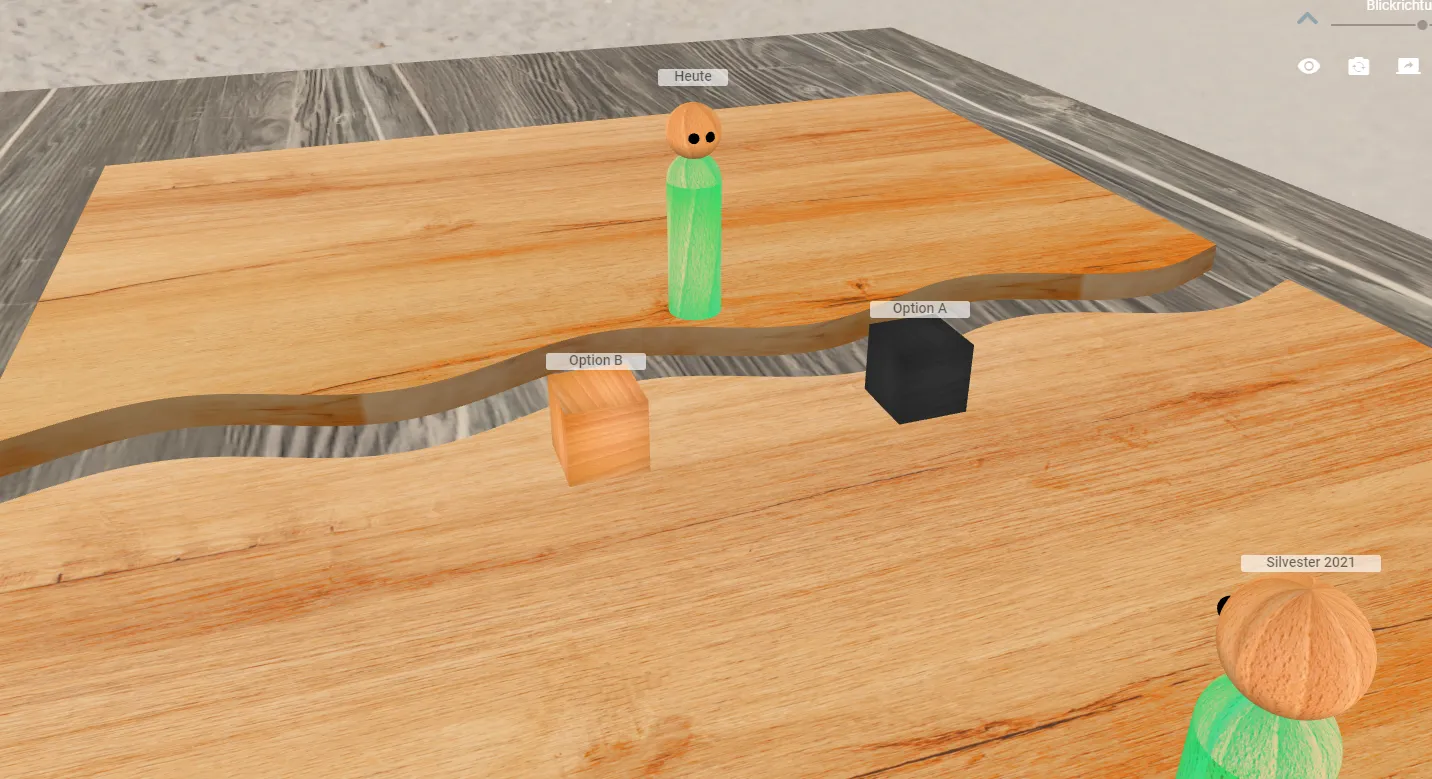
The wavy board can be pushed together, for example to explore what it takes to get closer to a decision or to the "point of smiling"
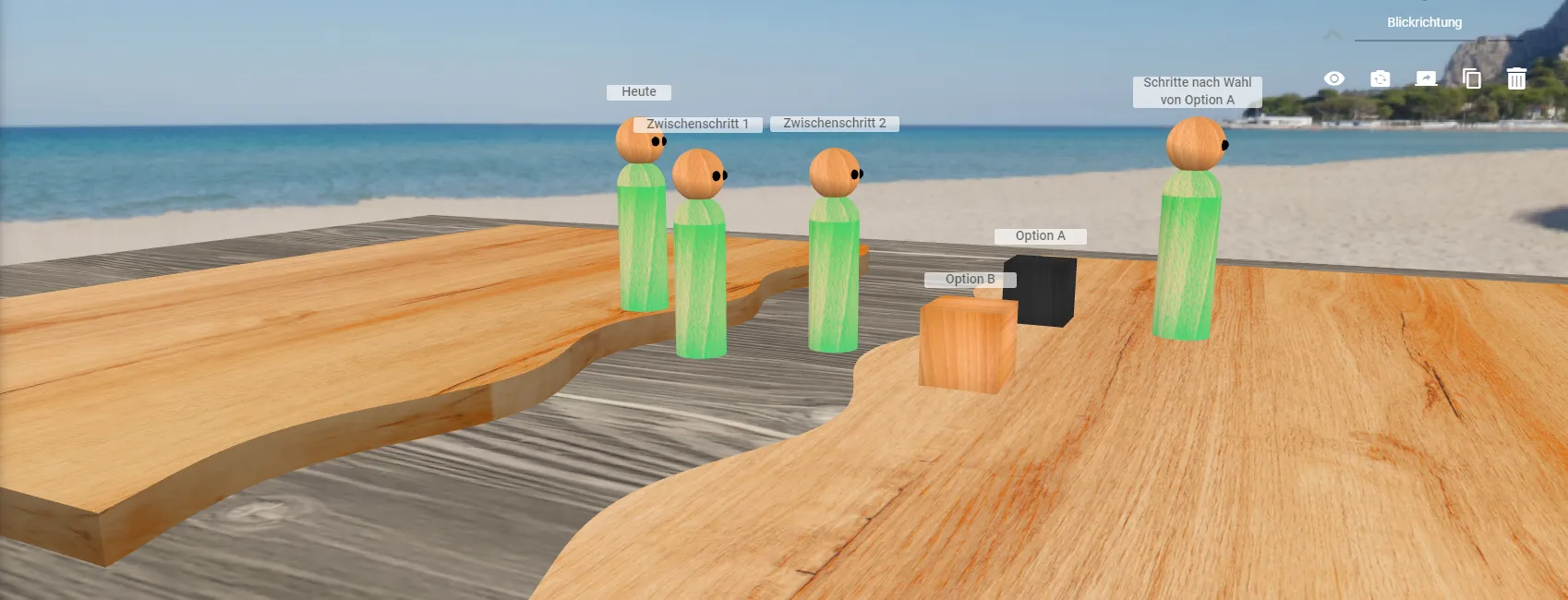
Between today and the future, further figures can also be placed in the sense of the future perfect, for example: "From the perspective of your future self on New Year's Eve, what were good intermediate steps towards making a decision?" Or: "Let's assume you have chosen option A. What do you do first? What second?" and so on (see screenshot 4).
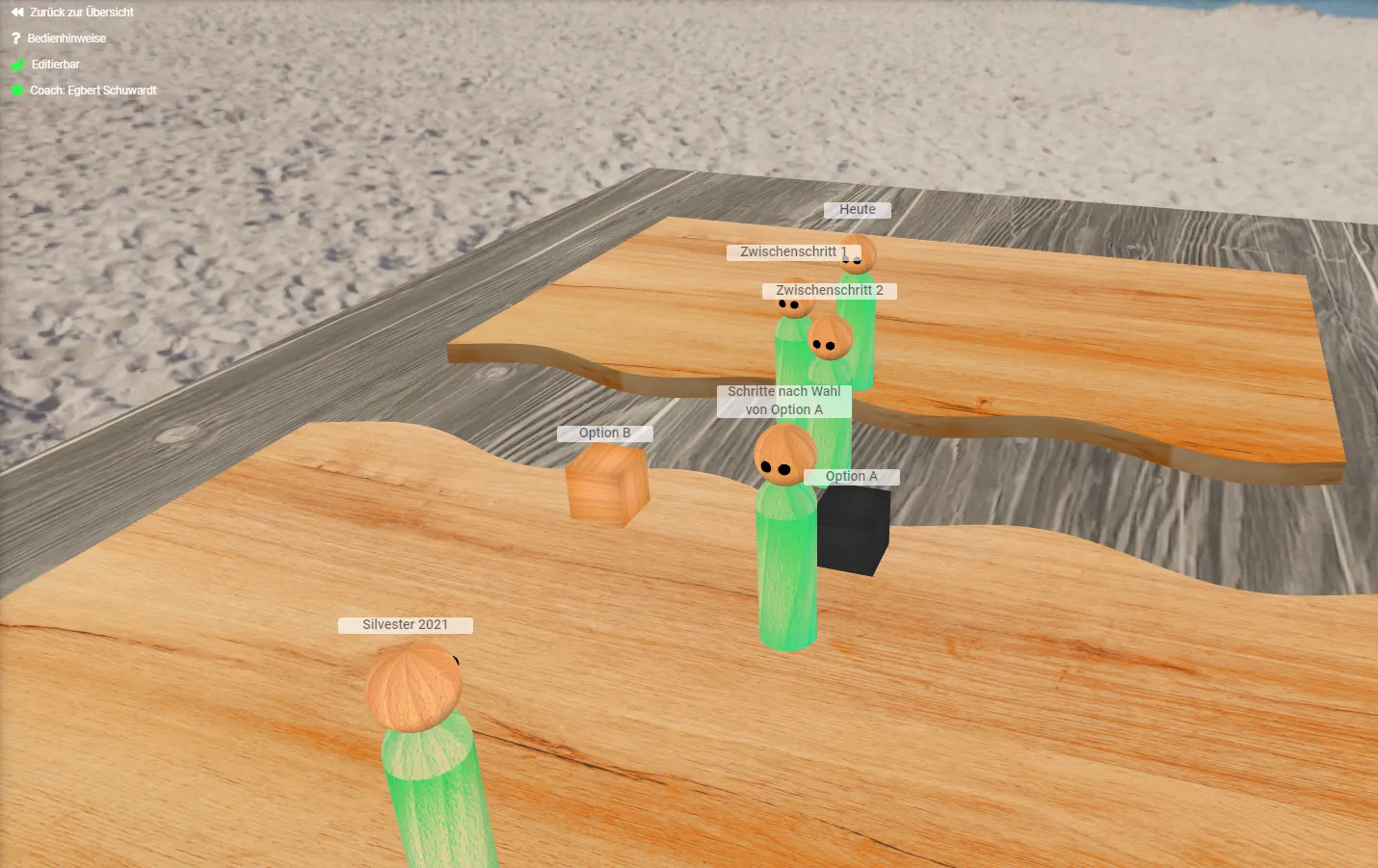
An example constellation of the future perfect with possible intermediate steps
Have fun trying out this variant.
Yours, Egbert Schuwardt
Mediator | Coach | Consultant
https://www.schuwardt.de/