The Inner Team in Online Coaching: Making Inner Voices and Conflicts Visible Digitally
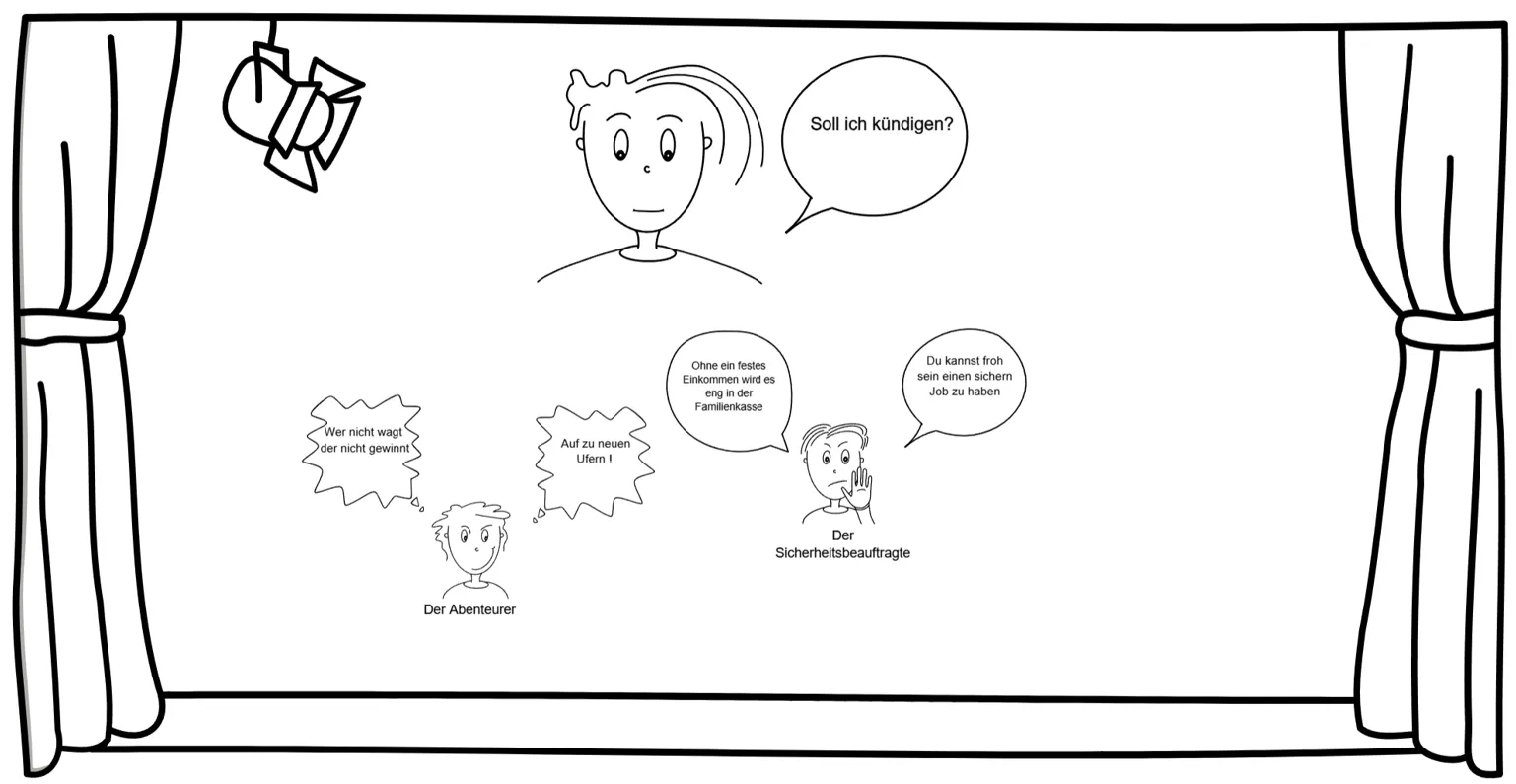
"Should I quit my job?"
At first glance, that is a single question.
Inside, however, very different answers can arise.
The adventurer calls out:
"Nothing ventured, nothing gained."
"Off to new shores!"
The safety officer counters:
"You should be glad to have a secure job."
"Without a steady income, the family budget gets tight."
Who is right?
Maybe both.
This is exactly where work with the Inner Team begins. Different inner voices become visible and receive a name, a position and a voice.
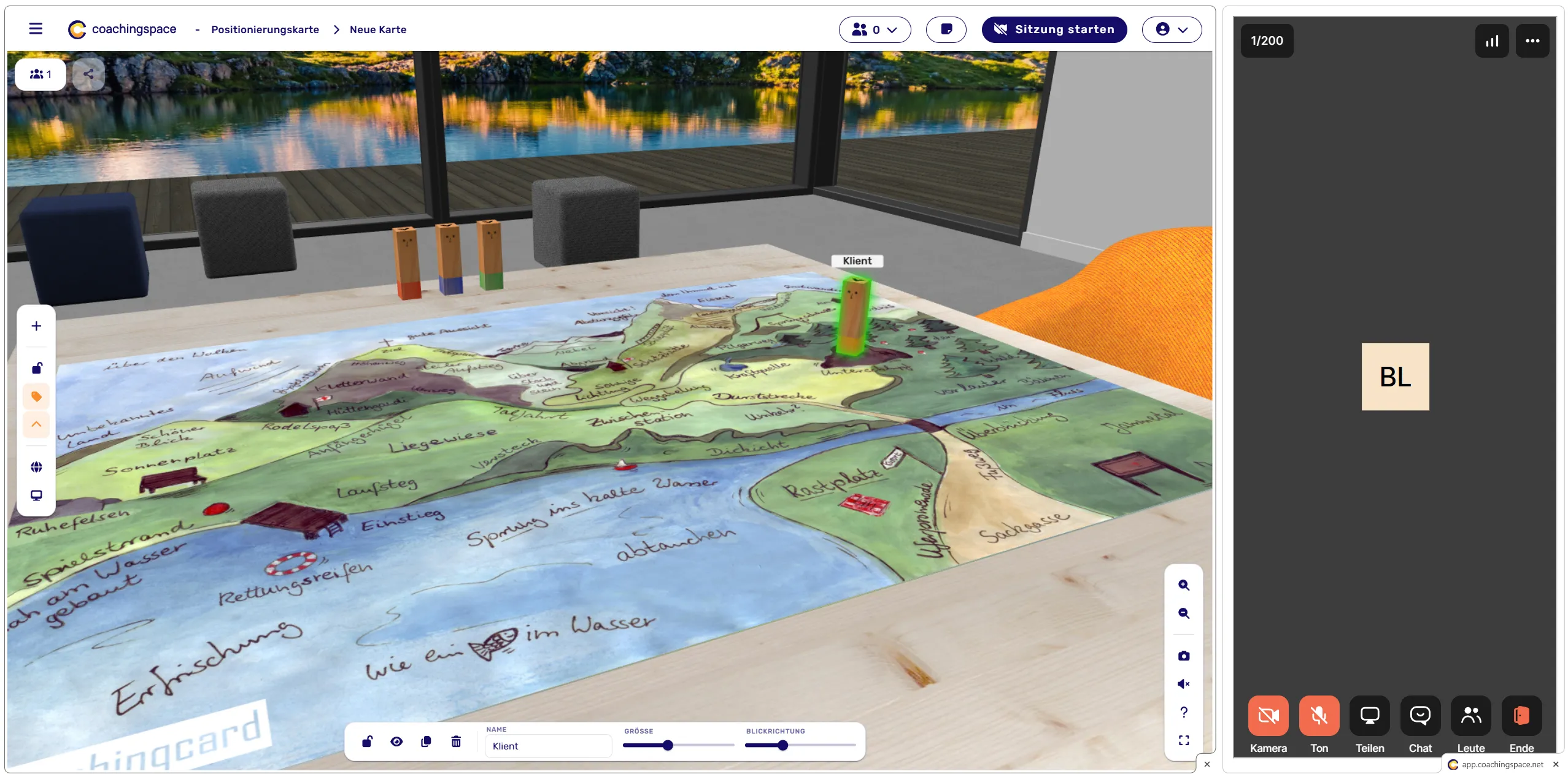
In coachingspace, the Inner Team can also be set up and worked on together in the virtual coaching room. A new extension now makes it possible to assign several individual speech bubbles to one inner part.
At first, that sounds like a small technical change.
Methodically, however, it contains a fascinating question:
When does an inner part have several things to say, and when is a new member of the Inner Team actually speaking?
What is the Inner Team?
The Inner Team model was developed by Friedemann Schulz von Thun. It assumes that in many situations, people experience different inner voices.
One voice says:
"Do it!"
Another warns:
"Be careful."
A third reminds you:
"Think of the others too."
And somewhere, a quieter voice might speak up:
"What do you actually want yourself?"
Especially with difficult decisions, conflicts or change processes, different inner positions can be active at the same time.
That does not mean a person does not know what they want. Often, different parts of a person know quite precisely what they want. They just do not necessarily want the same thing.
So in coaching, the sentence
"I just can't decide."
can turn into a more differentiated view:
"One part of me wants to change something."
"Another part wants security."
"And yet another part doesn't want to disappoint anyone."
Through work with the Inner Team, an initially diffuse inner conflict becomes a visible and workable inner dynamic.
Taking the Inner Team further digitally
The digital implementation of the Inner Team in coachingspace is continuously evolving.
We are especially glad about our collaboration with the Schulz von Thun Institute, which advises us on its further development.
Together we also offer workshops on working with the Inner Team in coachingspace. They combine the professional depth and methodical tradition of the model with the possibilities of an interactive virtual coaching room.
Because even in online coaching, work with the Inner Team does not have to stay limited to a conversation or a two-dimensional representation.
The individual inner parts can be set up in the virtual room, named, positioned and connected with their statements.
The Inner Team is thus not just talked about.
It becomes visible and workable together.
Setting up the Inner Team in the virtual coaching room
The work often starts with a concrete question.
For example:
Should I change jobs?
How do I want to behave in this conflict?
Why is it so hard for me to say no?
How do I want to show up as a leader?
What keeps me from making a decision?
Then you explore which inner voices speak up on this question.
Very different team members can become visible:
the adventurer
the cautious one
the perfectionist
the brave one
the driver
the harmony seeker
the safety officer
the critic
the experienced professional
Importantly, the Inner Team is not a ready-made typology.
The names and meanings of the individual team members emerge from the client's individual experience.
Every person assembles their own Inner Team.
Why visualize inner voices?
As long as different thoughts happen only in the head, they can be hard to tell apart.
Everything speaks at once.
Through visualization, the individual voices can first be separated and then put in relation to each other.
In the virtual room, additional questions arise:
Which part stands right at the front?
Who stands in the background?
Which voice is especially present?
Who stands close to the person?
Which parts are connected with each other?
Who is barely heard?
Which part takes up a lot of space?
Who might still be missing?
The spatial arrangement is not just decoration.
It can become part of the coaching process itself.
New: multiple speech bubbles for one inner part
In coachingspace, the statements of the inner team members can be made directly visible with speech bubbles.
Until now, each part could be given one speech bubble.
Now an inner team member can be given several individual speech bubbles.
Because sometimes an inner part really has more than one sentence to say.
The adventurer in our example says:
"Nothing ventured, nothing gained."
and:
"Off to new shores!"
Both statements are close in content.
They express departure, readiness for change and the willingness to take a risk.
So it can make sense to assign both statements to the same inner part.
But it is not always that simple.
One voice, several statements, or a new inner part after all?
The option of multiple speech bubbles opens up new freedom. At the same time, it presents coaches and clients with a methodically interesting question:
Do these statements really belong to the same inner part?
Or is another member of the Inner Team perhaps already speaking up here?
Let's look again at the example with the question:
"Should I quit my job?"
The safety officer says:
"You should be glad to have a secure job."
and:
"Without a steady income, the family budget gets tight."
Both statements can well belong to the safety officer.
His concern could be to preserve stability, limit risks and protect the person from the possible consequences of a rash decision.
At the same time, the second statement could also hint that another part is speaking up.
Perhaps a treasurer, who watches specifically over the family's financial situation.
And exactly this question can already be part of the coaching:
Is this still the same voice?
Does this part have several arguments?
Or are we actually hearing someone new?
Not every statement automatically needs its own part
One possible consequence would be to set up a new inner part for every new nuance.
The safety officer is then perhaps joined by a treasurer. Then a family provider may speak up. And finally a future planner.
That can make sense if these voices really represent different concerns, needs or functions.
But it can also make the constellation unnecessarily complex.
If every single statement immediately becomes a new team member, the Inner Team quickly grows large and confusing. Attention can then increasingly shift to how many more parts can be found, instead of the actual coaching question.
Sometimes the more important question is:
What does the safety officer need?
What would have to happen for him to agree to a career change?
What kind of security would be necessary?
What information is he missing?
Under what conditions could he give the adventurer a little more room?
Maybe that requires a treasurer of his own.
But maybe not.
The technology does not make the methodical decision for you
Therein lies an important point.
The option of using several speech bubbles does not mean a part should always get as many statements as possible.
Nor does the method mean that every new statement necessarily needs a new part.
Coaches and clients can decide how differentiated they want the representation of the Inner Team to be.
Some may deliberately work very clearly with one central statement per part.
Others want to give a team member several related messages.
Both are possible.
What matters is an attentive eye on the process.
Several speech bubbles can make a part visible in more detail. They can also be a hint that a part not yet recognized is knocking at the door.
The technical possibility creates freedom.
The methodical decision remains part of the coaching.
A practical example: should I quit?
In our example, a person is occupied with the question:
"Should I quit my job?"
Two inner team members stand out particularly clearly at first.
The adventurer
He says:
"Nothing ventured, nothing gained."
"Off to new shores!"
His concern is clear.
He wants change.
He sees possibilities.
He does not want to stay in an unsatisfying situation out of fear of uncertainty.
The safety officer
He says:
"You should be glad to have a secure job."
"Without a steady income, the family budget gets tight."
His concern is understandable too.
He does not want to prevent change.
Rather, he may want to prevent change from happening rashly.
Suddenly the question is no longer just:
"Should I quit or not?"
Instead, new questions can arise:
What does the adventurer need?
What does the safety officer need?
What does each of them want to achieve for the person?
What does the safety officer want to protect against?
What does the adventurer fear if everything stays as it is?
Under what conditions could both agree to a shared solution?
Maybe the solution is not:
"Quit immediately."
And not:
"Definitely stay."
Maybe a third option emerges:
"I actively start looking for a new position and only quit once a solid alternative is in place."
The inner conflict then does not have to be resolved by one team member winning.
A solution may emerge that takes the important concerns of several inner voices into account.
From inner opposition to inner dialogue
The goal of working with the Inner Team is not necessarily to silence individual voices.
Even unpleasant or disruptive inner parts can have an important function.
The inner critic may want to protect against rejection.
The cautious one wants to limit risks.
The driver wants to enable success.
The harmony seeker wants to preserve relationships.
The safety officer wants to guarantee stability.
In coaching, you can therefore explore:
What is the positive intention of this part?
What does it want to protect against?
What does it need?
Which other team members should be heard more?
Which voices could cooperate?
Who should take the inner lead in the current situation?
Step by step, inner opposition can thus turn into inner dialogue.
The spatial arrangement as part of the coaching work
In the virtual coaching room, you can change more than the statements of the inner team members.
Their positions can also be part of the process.
What happens when a very dominant part steps back a little?
What changes when a previously barely heard voice comes closer?
Which parts should stand next to each other?
Who needs more distance?
Which team member should stand at the front in a specific situation?
What would a helpful new arrangement of the Inner Team look like?
Alongside the current picture, a possible target picture can thus emerge.
The client then not only looks at the present inner situation but can try out a different inner order.
The Inner Team in leadership coaching
The method is especially well suited to working with leaders.
Leadership is often shaped by contradictory demands.
A leader wants to decide clearly and to involve people at the same time.
They want to take responsibility and to hand over responsibility at the same time.
They want to drive change and to give security at the same time.
They want to allow closeness and to keep professional distance at the same time.
In such situations, different inner voices can become visible:
"I have to make a clear decision now."
"I don't want to pass anyone over."
"I must not show uncertainty."
"Honestly, I don't know yet myself what is right."
The Inner Team can help sort these different demands and develop a coherent inner leadership position.
The Inner Team in conflict coaching
The method can also be helpful in conflicts.
People often experience different impulses at the same time:
"I finally want to speak my mind."
"I don't want to let the conflict escalate."
"I want to be understood."
"Actually, I just want some peace."
When these voices become visible, you can examine more closely which needs and fears stand behind your own behavior.
That can be important preparation for a difficult conversation.
Combining the Inner Team with other coaching methods
Working in the virtual room makes it possible to connect the Inner Team with other methods.
Moderation cards, for example, can make values, needs or central questions visible.
Additional figures can represent relevant people from the outer system.
Rings or other spatial elements can mark belonging and boundaries.
This lets you explore:
Which inner part reacts especially strongly to a specific person?
Which voice takes the lead in a conflict?
Which part is barely heard in a certain situation?
Which inner team members stand for different values?
In this way, the Inner Team can grow into a more comprehensive coaching landscape.
What is the advantage of the Inner Team in online coaching?
The Inner Team lends itself particularly well to visual and spatial work.
In a virtual coaching room, the inner voices can be built up, named, positioned and changed together.
This makes the inner voices distinguishable from each other.
Statements can be assigned directly to the respective parts.
Several messages of one part can be made visible.
Relationships between team members become spatially recognizable.
Changes can be tried out immediately.
The Inner Team is not just described.
It takes shape as a shared workspace in the virtual room.
Frequently asked questions about the Inner Team in online coaching
What is the Inner Team?
The Inner Team is a model developed by Friedemann Schulz von Thun that makes a person's different inner voices and positions visible and workable.
Can the Inner Team also be used online?
Yes. In a virtual coaching room, inner team members can be set up as figures, positioned spatially and connected with their statements.
Why can several speech bubbles per part be useful?
An inner part can have several related messages. Multiple speech bubbles make it possible to show these statements at the same time.
When should a new part be set up instead?
If statements clearly represent different concerns, functions or needs, it can make sense to check whether another inner team member is actually speaking. This decision should follow the client's individual experience and the benefit for the coaching process.
Should every part have only one statement?
That is one possible methodical way of working, but not a technical requirement. In coachingspace you can work with one central statement or with several speech bubbles per part.
Is the Inner Team only suitable for decision coaching?
No. The method can be used for decisions, conflicts, leadership topics, role clarification, change processes and personal development questions, among others.
Do the inner parts have to be predefined?
No. The inner team members emerge from the client's individual experience. Their names and meanings are developed in the coaching process.
Conclusion: how many voices do we really hear?
Working with the Inner Team helps make inner diversity visible and workable.
Difficult decisions in particular often show:
People do not simply "not know what they want".
Rather, different parts of them want different things.
The option of assigning several speech bubbles to one inner part can help show its messages in more detail.
At the same time, the methodical question is always worth asking:
Is the same part really still speaking, or are we already hearing another member of the Inner Team?
There is no blanket answer to that.
And that is exactly what matters.
Because digital tools should not standardize professional coaching. They should give coaches and clients the freedom to choose the representation that helps the process at hand.
Sometimes an inner part has several things to say.
And sometimes the second statement shows that someone else is sitting at the table.
Both can be a valuable starting point for the next step in coaching.