Online coaching is more than Zoom: why digital consulting needs a method room of its own
A camera.
A microphone.
Two people on a screen.
Is that already online coaching?
Of course coaching can take place over a video conference.
A good conversation remains a good conversation, whether two people meet in a consulting room or across a screen.
But if we understand online coaching only as video conferencing, we transfer just one part of professional coaching work into the digital space.
Because coaching often consists of more than conversation.
In person, coaches work with:
figures
cards
flipcharts
constellation boards
floor anchors
constellations
worksheets
notes
scaling exercises
and many other methods.
Why should all of that disappear just because the coaching happens online?
A video conference digitizes the conversation
Video conferencing systems solve one important problem.
They let people talk to each other even though they are in different places.
For many coaching processes, that can already be enough.
But a video conference initially only answers the question:
How can we communicate with each other?
Professional digital coaching asks further questions:
How can we work together?
How do we visualize complex situations?
How do we represent relationships spatially?
How do we capture insights?
How do we pick up earlier results again?
How do we accompany a process between two sessions?
This is exactly where the difference begins between a plain video conference and a digital coaching room.
The physical coaching room is full of methods
Picture a classic coaching room.
It might hold:
a flipchart
a whiteboard
a constellation board
a box of figures
several card sets
moderation cards
pens
worksheets.
The coach decides during the process what might be helpful.
Maybe the session starts with a conversation.
Then, spontaneously, an idea appears:
"Why don't you set the situation up on the board?"
Or:
"Which of these cards describes your situation?"
Or:
"Let's write down those two values and place them opposite each other."
The method emerges from the process.
When coaching moves online, however, something strange often happens.
The entire method room disappears.
What remains is:
the video conference.
It does not have to be that way.
From the video conference room to a digital method room
A digital coaching room can be more than a technical connection between two people.
It can become a workspace in its own right.
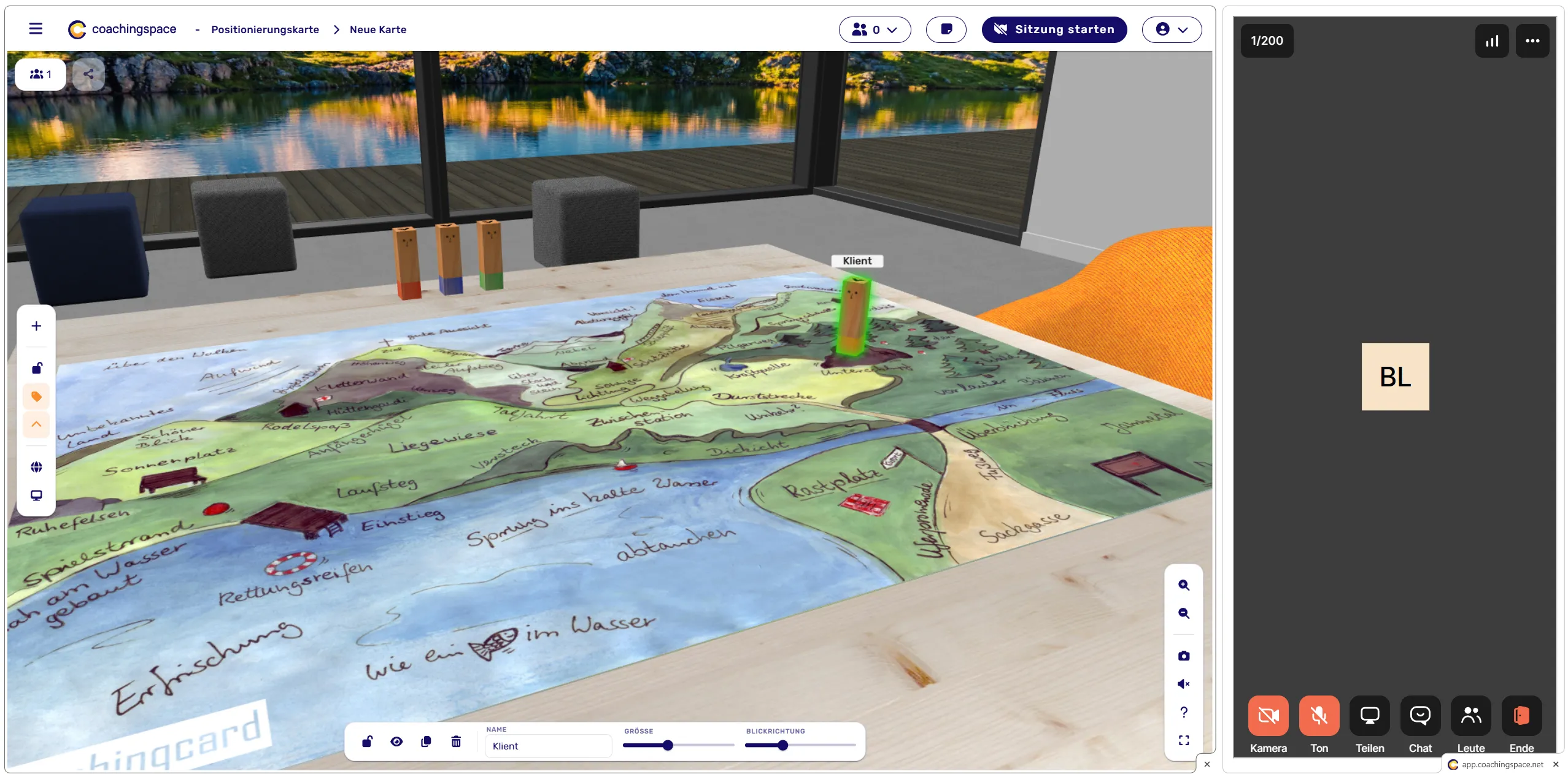
Figures can represent relationships.
Moderation cards can make values and topics visible.
Images can symbolize resources.
Rings can mark belonging.
Walls can represent boundaries.
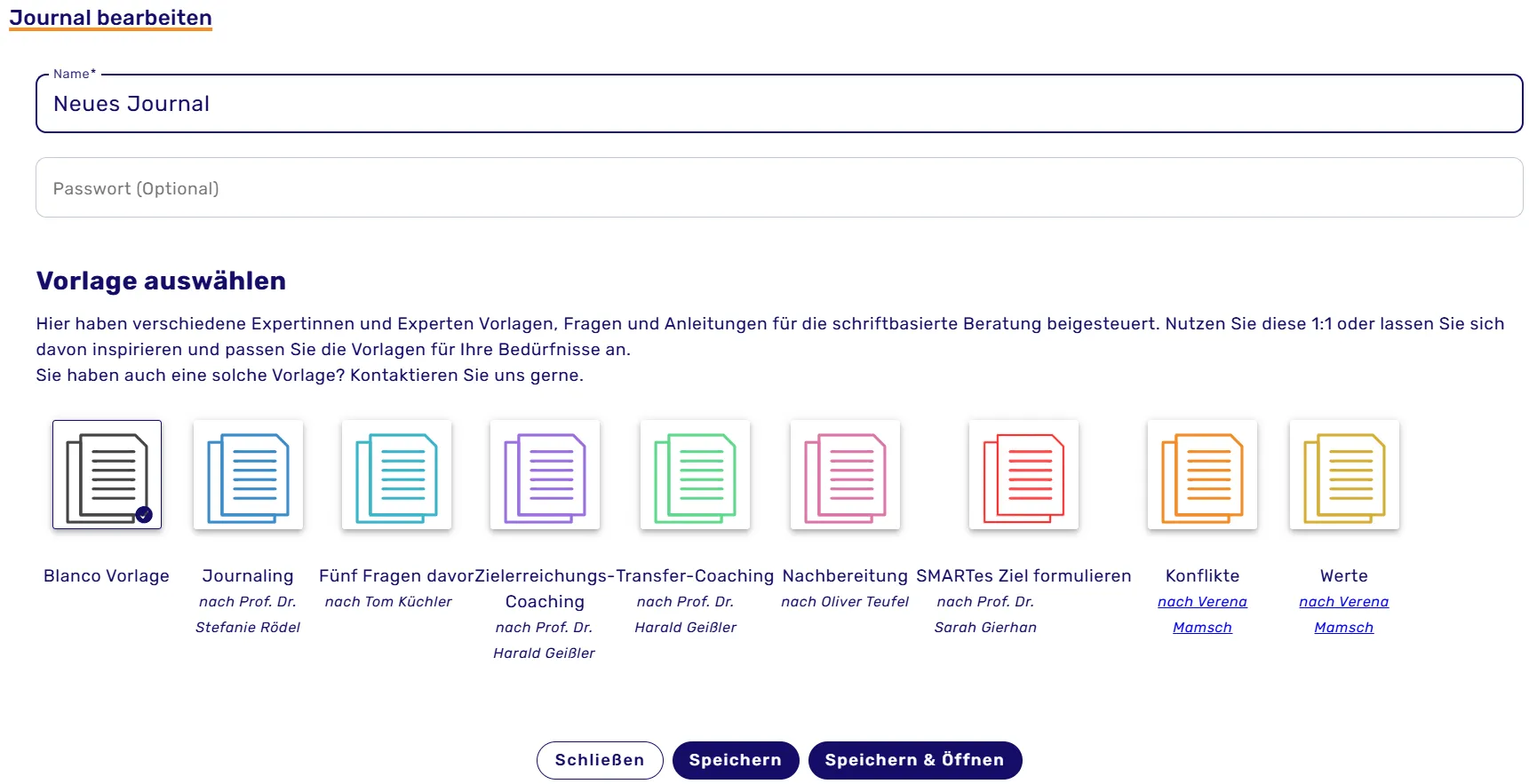
Journals can accompany reflection between sessions.
The central idea is:
Not only the conversation goes digital. The methodical work also gets a digital room of its own.
Example: a conflict in leadership coaching
A leader describes a conflict with a long-standing employee.
In the conversation, this picture emerges:
The leader experiences herself as agile, flexible and fast.
The employee is perceived as security-oriented, experienced and reliable.
Now the coach could simply keep asking questions.
Or the situation is made visible.
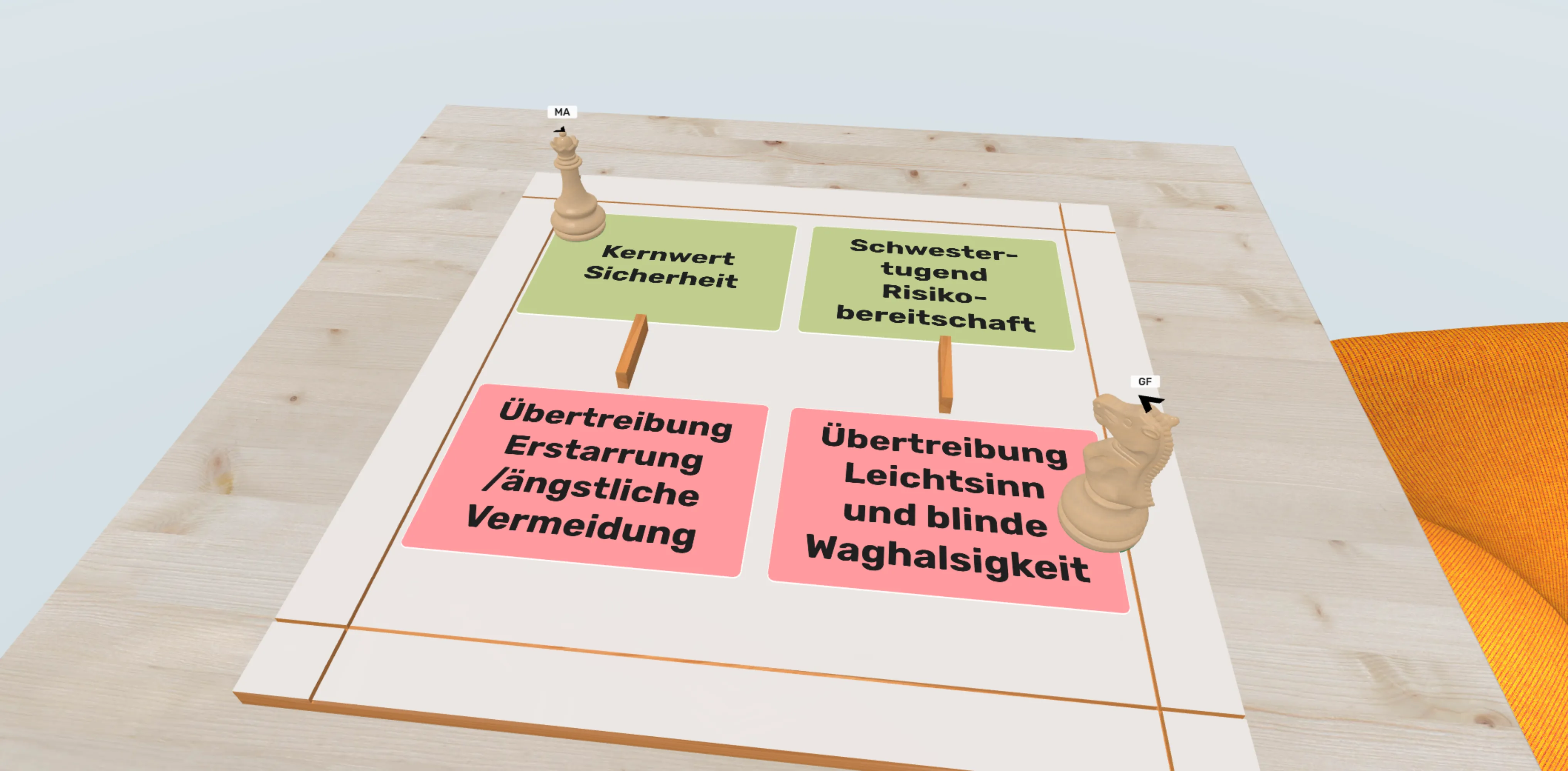
The leader chooses a chess piece for herself:
the knight.
For the employee she chooses:
the queen.
With moderation cards, a values and development square is laid out.
On one side:
security
On the other:
willingness to take risks
Below them, the possible exaggerations:
anxious avoidance
and
recklessness.
Now the conflict no longer lives only in the conversation.
It stands in the room.
The leader then switches position and looks at the situation from the employee's perspective.
Suddenly her own knight looks different.
What feels like agility from her own perspective can look like erratic jumping or recklessness from over there.
And the employee?
Maybe her wish for security is not simply resistance to change.
Maybe she fulfills an important function in the company:
making sure that, with all the agility, things stay on solid ground.
That is more than a video conference.
The digital room becomes part of the intervention.
Digital does not mean copying the in-person room as exactly as possible
The obvious idea would be to rebuild every method from the physical coaching room digitally, as exactly as possible.
But that falls short.
A digital room has possibilities of its own.
A constellation can be saved and picked up again later.
A client can reflect between two sessions.
An earlier state can be compared with a later one.
Your own images can be brought into the process.
Methods can be combined with one another.
Spatial situations can be viewed from different perspectives.
Digital coaching should therefore not only ask:
"How do we copy the in-person experience?"
But:
"What becomes additionally possible in the digital room?"
A coaching process is more than its sessions
Many coaching offers are organized like this:
Appointment.
Video conference.
End.
Next appointment.
But development also happens in between.
An insight keeps working.
A conflict flares up again.
A person notices one of their own patterns.
A decision shifts.
A value suddenly becomes tangible in everyday life.
Digital journals can capture such observations.
A coaching process can then create a connection between:
the session
everyday life
reflection
and the next session.
Online coaching thus becomes not only location-independent.
It can also be designed as a more continuous process.
The coach needs freedom of method
One danger of digital coaching software is that the software dictates how coaching should happen.
There is method A.
Method B.
Method C.
The coach picks one and follows the prescribed sequence.
Professional coaching, however, often works differently.
Coaches combine methods.
They adapt approaches.
They develop their own interventions.
They respond to what emerges in the process.
That is why a digital method room also needs open tools.
A moderation card is not a method.
But four moderation cards can become a values and development square.
Or a decision matrix.
Or a timeline.
Or a model of your own.
A figure is not a method.
But it can represent a leader.
An employee.
An inner part.
An organization.
Or a goal.
The method emerges through professional use.
Not everything needs a digital tool
For all the enthusiasm about digital methods:
Not every intervention has to be visualized.
Not every session needs a 3D constellation board.
Not every topic needs a journal.
And not every question needs a digital tool.
Sometimes a conversation is exactly right.
Sometimes a whiteboard.
Sometimes a constellation.
The quality of professional digital consulting therefore does not show in using as many features as possible.
It also shows in not using the right tool when it is not needed.
What should a professional online coaching environment make possible?
A digital coaching environment can connect several levels:
Communication
Coach and client must be able to talk securely.
Methodical work
Visual and spatial methods should be available where they serve the process.
Documentation
Relevant information and results should be reusable in a structured way.
Process support
Reflection can also happen between sessions.
Freedom of method
Coaches should be able to integrate their own approaches and materials.
Data protection
Confidential coaching processes need an appropriate technical and organizational foundation.
Not every coach needs every one of these functions.
But professional online coaching platforms should answer more than the question:
"Can we see and hear each other?"
The future of online coaching is not a better video conference
Video conferencing will remain a central part of online coaching.
But the more interesting development lies elsewhere.
In digital rooms that enable not just communication.
But:
Interaction.
Visualization.
Reflection.
Methodical work.
Changes of perspective.
Process support.
The question of the future is therefore not:
Which video conferencing software has the best camera quality?
But:
How do we design digital rooms in which professional consulting can keep and further develop its methodical variety?
That is exactly the question we are working on with coachingspace.
Frequently asked questions about online coaching and video conferencing
Is a video conference enough for online coaching?
For many conversational formats, a video conference can be enough. If coaches also want to work with constellations, figures, coaching cards, journals or other methods, specialized digital tools can extend the process.
What is an online coaching platform?
Besides video communication, an online coaching platform can provide further functions for coaching processes, such as client management, digital methods, documentation or ways to reflect between sessions.
What distinguishes online coaching from a normal video call?
The difference does not necessarily lie in the technology of the conversation, but in the professional design of the coaching process. Online coaching can include methodical work, visualization and process support alongside the conversation.
Does good online coaching need many digital tools?
No. What matters is not the number of tools but how well they fit the coaching process.
Can in-person methods be used online?
Many methods can be transferred to digital or further developed for the digital space. These include, for example, constellation board work, constellations, the Inner Team, values work and coaching cards.
Conclusion: online coaching begins where we take the digital room seriously
A video conference can be an excellent place for a coaching conversation.
But professional coaching often consists of more than conversation.
It lives on questions.
On images.
On positions.
On relationships.
On reflection.
On methods.
And sometimes on actually seeing something in front of you that was hard to put into words before.
That is why we believe:
Online coaching should not try to imitate a physical consulting room poorly through a screen.
It should use the possibilities of the digital space.
A video conference digitizes the conversation.
A digital method room can extend the coaching process.
And that is where the most exciting development in online coaching begins for us.