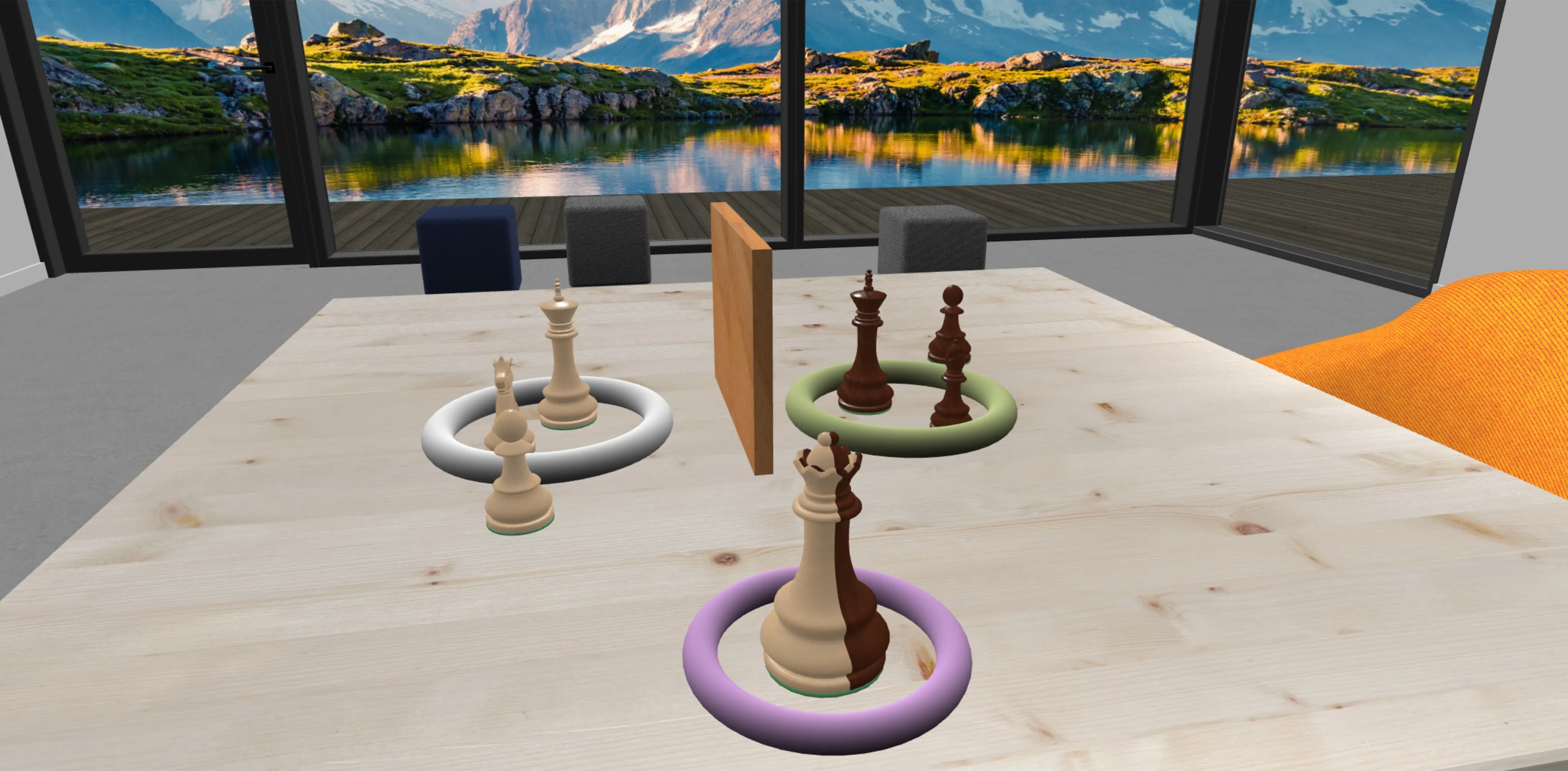
What if your organization were a chessboard?
Which piece would you be yourself? Which piece would be your boss? Which ones your employees? Who moves freely? Who covers whom? Who stands at the center? And which pieces might be missing altogether?
With two new features, coachingspace significantly extends the methodical possibilities in the virtual coaching room:
Chess pieces for constellation work, and freely writable moderation cards for almost anything coaches, supervisors and consultants want to make visible in the room.
How powerful the combination of both tools can be is shown by an example from a leadership coaching.
New feature 1: making organizations and relationships visible with chess pieces
Chess pieces are particularly well suited to working with leaders, teams and organizations. Every piece already brings its own symbolism and logic of movement.
The knight moves differently than the queen. The rook stands for something different than the pawn. The king counts as the central piece and is at the same time restricted in his freedom of movement.
Exactly these associations can be used in coaching.
For example, with questions like:
If your organization were a chessboard: which piece would you be?
Which piece stands for your boss?
Which pieces represent your employees?
Who can move freely?
Who protects whom?
Who stands in whose way?
Which pieces are overrepresented?
Which are missing?
What would happen if one piece changed its position?
Choosing a piece is often already the start of an intense reflection process.
Because the interesting question is not just:
"Which piece do you choose?"
But also:
"Why exactly this one?"
An example: knight meets queen
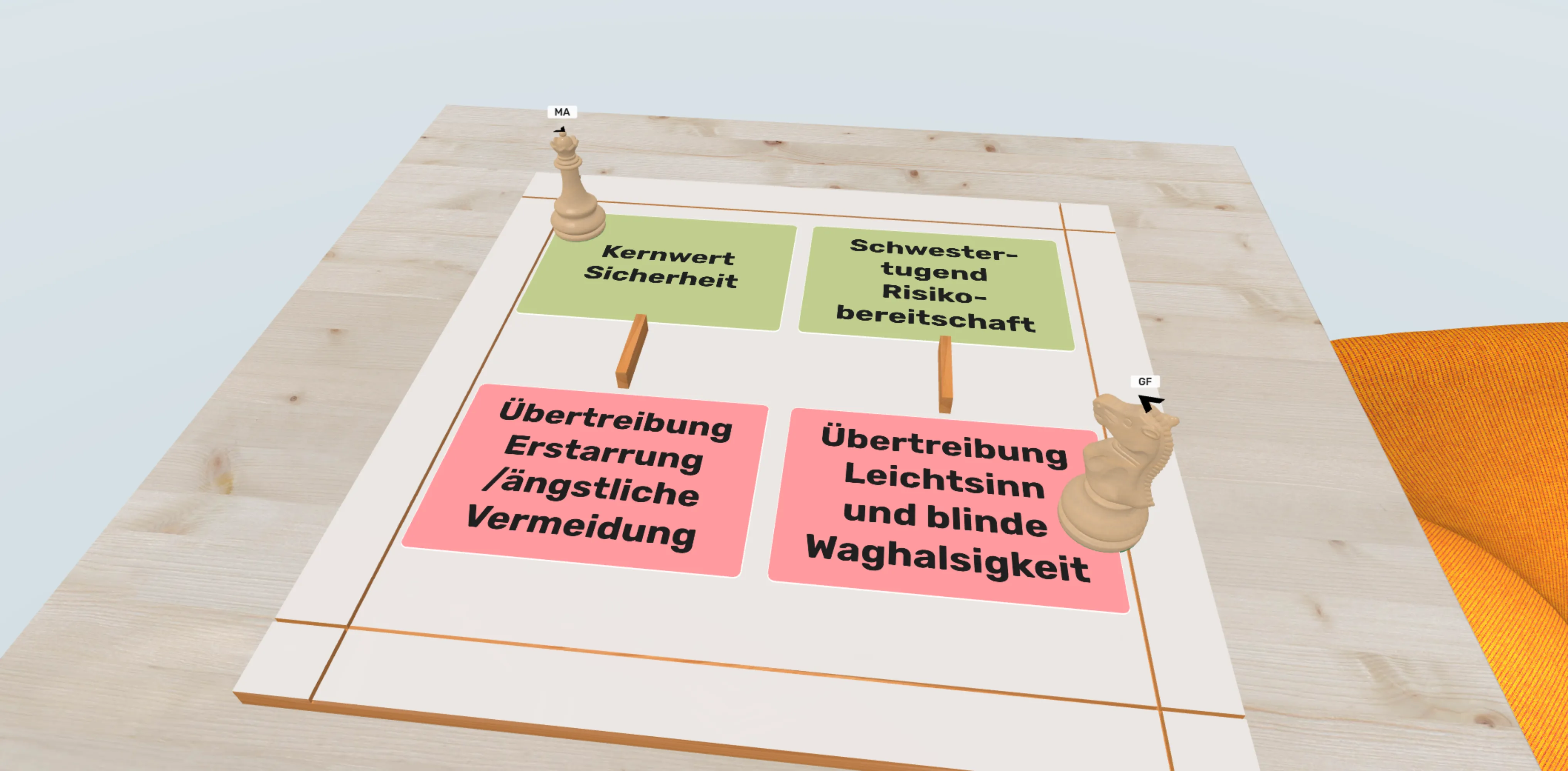
In a leadership coaching, the managing director represented himself as the knight.
His reasoning: he constantly has to react flexibly, work in an agile way, take unusual paths and be able to respond quickly to change.
A long-standing employee from accounting, on the other hand, was symbolized as the queen: experienced, central to the organization, with a comprehensive view and a strong focus on security and reliability.
Between the two, conflicts kept flaring up.
What the leader understood as necessary flexibility and agility was partly experienced by the employee as erratic behavior and a lack of reliability.
What the employee in turn understood as necessary security and diligence partly appeared to the leader as rigidity or avoidance of change.
The chess pieces made these different roles and self-images visible in the virtual 3D room.
But the methodical work was not finished yet.
Now the second new feature came into play.
New feature 2: moderation cards as a universal tool in the virtual coaching room
Also new in coachingspace: moderation cards that can be individually labeled and laid out in the virtual room.
And that is exactly their strength.
Because a moderation card does not prescribe a method.
It can be whatever the coach, the supervisor or the client needs right now:
A value, a question, a hypothesis, a goal, an obstacle, a resource, a role, a process step, a position, or an entire theoretical model.
This lets you bring a wide range of methods and consulting approaches into the virtual room.
Moderation cards can be used, for example, for:
values and needs,
resources and obstacles,
goals and next steps,
pro and con positions,
scaling exercises,
decision options,
hypotheses,
stakeholders,
process phases,
team roles,
beliefs,
inner voices,
conflict positions,
systemic questions,
or visualizing complete models.
So the moderation cards are not simply another method in coachingspace.
They are a tool that lets coaches bring their own methods into the virtual room.
Simply building a model yourself in the 3D room
In the leadership coaching described above, the moderation cards were used to build a values and development square directly in the virtual room.
On one side stood the core value:
Security
Opposite it, the complementary sister virtue:
Willingness to take risks
Because both qualities are needed.
Security without willingness to take risks can, in its exaggeration, turn into anxious avoidance and paralysis.
Willingness to take risks without security, on the other hand, can lead to recklessness and blind daring.
With four moderation cards, a complete values and development square thus emerged right in the virtual coaching room:
Security
↕
anxious avoidance and paralysis
and
Willingness to take risks
↕
recklessness and blind daring
The decisive point:
The values and development square did not have to be programmed as its own digital method.
It could simply be built in the room with the freely usable moderation cards.
And that is exactly what shows the real strength of this new feature.
Change of perspective in the virtual 3D room: the leader looks at the situation from the employee's position.
One tool, many methods
Today a values and development square.
Tomorrow perhaps a decision matrix.
After that a stakeholder analysis, a timeline, a conflict model or a coaching concept of your own.
The moderation cards let coaches, supervisors and consultants bring their own methodical competence into the virtual room.
Instead of only being able to use ready-made digital methods, a flexible workspace emerges.
You want to lay out three decision options? Write them on three cards.
You want to contrast resources and obstacles? Set up two areas in the room.
You want to build your own model with six fields? Use six moderation cards.
You want to map a process with five stations? Arrange five cards in the room.
And then figures, objects or other elements can be positioned around them.
The moderation card thus becomes a methodical canvas.
Especially powerful: combining tools with each other
However, the real strength of a virtual coaching room does not show only in the individual tools.
It shows in how they can be combined.
In the leadership coaching described, these came together:
Chess pieces for the roles and people.
The 3D room for positions, relationships and perspectives.
Moderation cards for the values and development square.
The change of perspective for the actual reflection work.
In this way, an individual coaching process emerged from individual elements.
The chess pieces made visible who was facing whom.
The moderation cards made visible what it was really about.
And the spatial work made it possible to actually change perspective.
The decisive moment: taking the other side's perspective
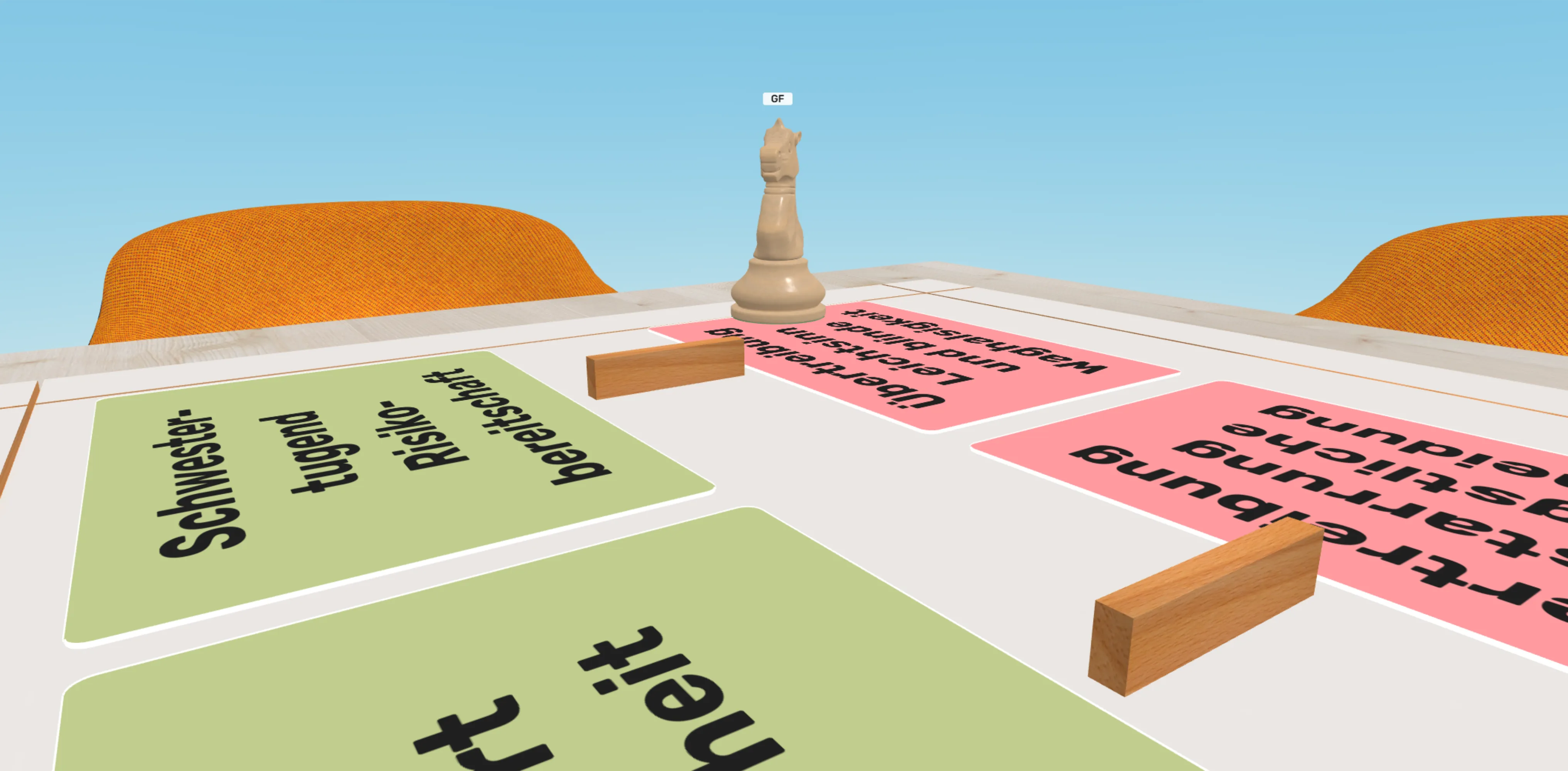 Change of perspective in the virtual 3D room: the leader looks at the situation from the employee's position.
The leader was invited to leave his own position and mentally step into the employee's role.
What does the "queen" see when she looks at the "knight"?
From the leader's perspective, the story was:
"I am flexible. I react with agility. I find new paths."
From the employee's perspective, however, the same behavior could feel very different:
"I don't know what will still be valid tomorrow. Decisions change constantly. I have to make sure we don't lose track."
Suddenly it became visible that behind the supposed resistance lay a quality.
The need for security was not simply a lack of readiness for change. It fulfilled an important function:
With all the movement, making sure things stay on solid ground.
At the same time, the other side could also be seen anew.
The knight was not simply erratic. His mobility, agility and ability to take unusual paths were important resources for the organization.
When a conflict becomes a field of development
The values and development square helped look at the conflict in a new way.
Not:
Who is right?
But:
Which quality lies behind the other person's behavior?
From:
"She constantly blocks change."
can come:
"She provides security and reliability, and could complement this quality with more willingness to take risks."
From:
"He is completely erratic."
can come:
"He brings flexibility and readiness for change, and could complement this quality with more security and continuity."
In this way, a personal standoff becomes a shared field of development.
Online coaching is more than a video conference
This example shows what we mean by a virtual coaching room.
Online coaching does not have to be limited to talking with each other over a video conference and occasionally sharing a screen.
In coachingspace, coaches, supervisors, consultants and their clients can work together in a virtual room.
They can:
set up figures,
make relationships spatially visible,
label and lay out moderation cards,
build their own models,
change perspectives,
move elements,
try out hypotheses
and combine different methodical tools with each other.
The result is a digital workspace where consulting is not only discussed but can be visualized and spatially experienced.
Two new features, countless possibilities
The new chess pieces and moderation cards exemplify two different kinds of methodical work.
The chess pieces bring strong metaphors. They invite reflection on roles, power, mobility, strategy and relationships.
The moderation cards, by contrast, are deliberately open. They can be labeled with almost anything and used for the widest range of methods.
One tool gives strong images. The other gives maximum methodical freedom.
And it gets especially interesting when both are combined.
In the coaching described, this combination:
chess pieces + moderation cards + 3D constellation + values and development square + change of perspective
produced an individual coaching process that would hardly have been possible in this form with a single ready-made tool.
For us, that is exactly the idea behind coachingspace:
Not to build a rigid digital copy of every conceivable coaching method, but to create a virtual room in which coaches can unfold their own methodical competence and creatively combine different tools.
Which method would you bring into the virtual room with moderation cards?
Today it was a values and development square.
But what would you make of it?
A decision landscape? A team constellation? Your own leadership model? A conflict matrix? A timeline? A resource landscape? A tetralemma? Or a method that could not be mapped digitally at all until now?
And if your organization were a chessboard:
Which piece would you be?
With the new chess pieces and moderation cards, coachingspace now offers even more ways to shape coaching, supervision and consulting in the virtual room, individually and with methodical variety.
We are curious what you will make of it.