Rings and walls in online coaching: making boundaries, belonging and systems visible in virtual space
Who actually belongs?
Where does a boundary run?
What protects?
What separates?
And what would have to change for a stuck system to get moving again?
In coaching, supervision and organizational consulting, boundaries, belonging and spatial structures often play a central role.
A team feels like a closed unit. A leader stands between two groups. Two departments work side by side but hardly with each other. A person formally belongs to a system and still experiences themselves as an outsider.
Much of this can be described in conversation.
Some of it, however, only becomes truly tangible when it stands visibly in the room.
With rings and walls in the virtual 3D room of coachingspace, coaches and supervisors can now integrate belonging, boundaries, protective spaces and barriers into their constellations.
The new elements prescribe no method and no interpretation.
A ring can mean belonging.
Or demarcation.
A wall can separate.
Or protect.
The meaning emerges in the coaching process.
Rings and walls as new elements for virtual constellations
With the new rings and walls, coachingspace extends the possibilities for systemic constellations in online coaching.
Rings can be used, for example, to make different areas visible:
teams
families
departments
organizational units
areas of responsibility
conflict parties
protective spaces
informal groups
or other systems.
Walls, in turn, can symbolize boundaries or barriers:
a communication barrier
a hierarchy
a conflict
an emotional distance
a taboo
an organizational separation
a personal boundary
or a necessary protection.
The decisive point:
The meaning is not prescribed by coachingspace.
The client decides what a ring or a wall stands for in each constellation.
One picture, many possible meanings
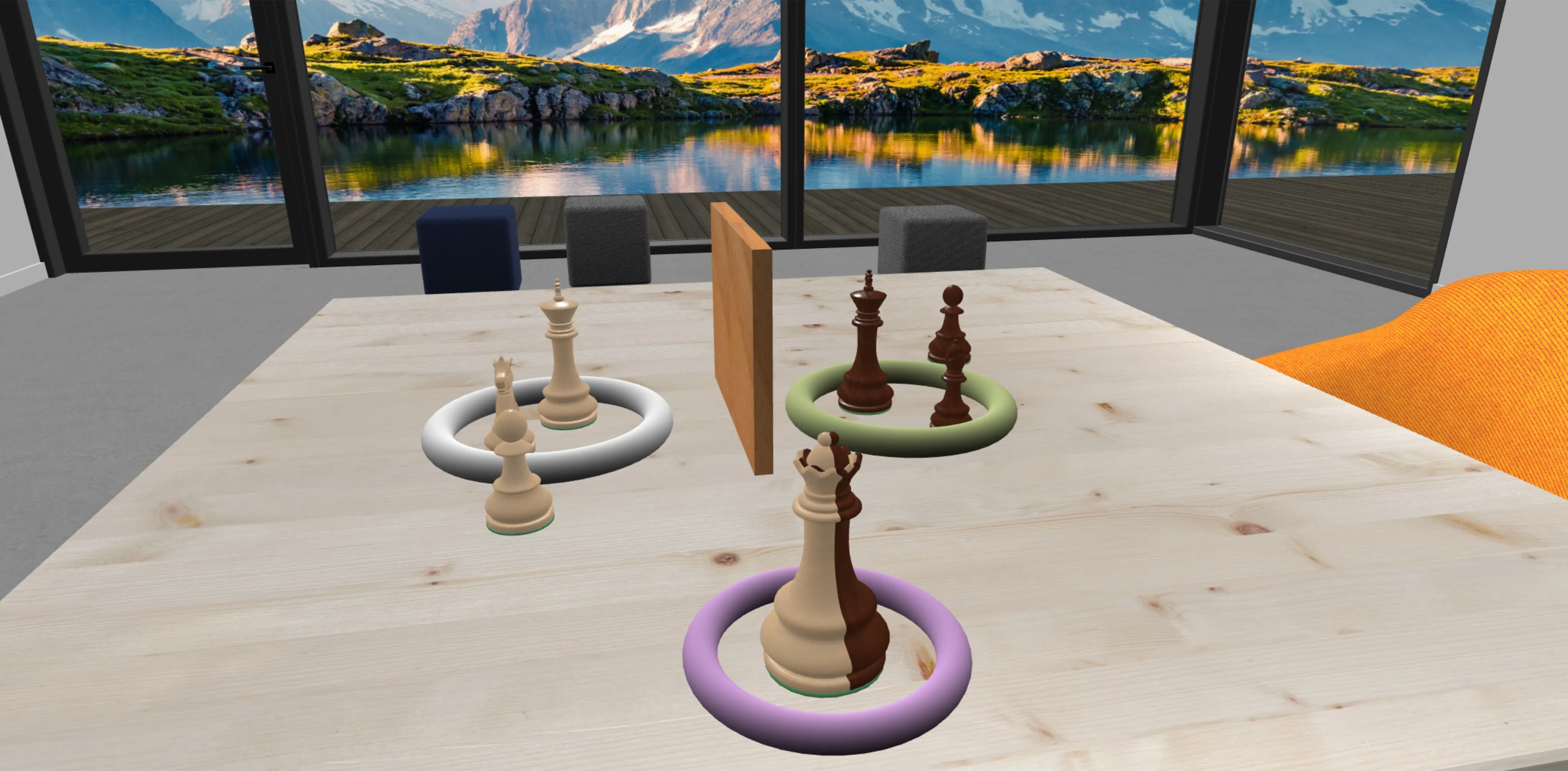
The following example shows how rings and walls can be used together with figures in a virtual constellation.
On the left is a group of light chess pieces inside a white ring.
On the right stands a group of dark pieces in a green ring.
Between the two groups is a wall.
Another figure stands in the foreground in its own violet ring.
What does this constellation mean?
The correct answer is:
We don't know yet.
Maybe the two groups stand for two departments that hardly communicate with each other.
Maybe they are two camps in a conflict.
Maybe the rings symbolize two teams, families or organizational units.
The wall could stand for a communication barrier.
Or for a necessary boundary.
Or for a topic no one talks about.
And the single figure in the foreground?
Maybe she is a leader standing between the two systems.
Maybe she formally belongs to one of the groups but experiences herself as an outsider.
Maybe she deliberately takes a neutral position.
Or she needs a protective space of her own.
That is exactly the strength of spatial work: the meaning does not come from the digital tool but from the person working with it.
Rings make belonging visible
A ring can mark an area in the virtual room.
Who stands inside?
Who stands outside?
Who stands at the edge?
Who formally belongs but does not feel they belong?
Who is perhaps in several systems at once?
The position of a single figure alone can trigger important questions.
Imagine, for example, a new leader.
Formally she belongs to the team.
In a constellation, she places all team members inside a ring but positions her own figure outside.
Asked:
"What does this position mean to you?"
she might answer:
"I am officially part of the team, but I don't really feel like I belong yet."
Suddenly something becomes visible that was perhaps hard to grasp in conversation.
The topic may not only be:
"How do I lead this team?"
But also:
"Where actually is my place in this system?"
Belonging is not always clear-cut
Especially in organizations, people often belong to several systems at once.
A leader is part of her team and at the same time part of the leadership level.
A project lead belongs to her own department and at the same time to a cross-functional project.
A person takes on a new role but still feels strongly connected to their former group.
Rings can help make such multiple belongings visible.
A figure can:
stand inside a system
stand outside it
be positioned at the edge
stand between two systems
or receive an area of its own.
The spatial position itself thereby becomes a subject of the coaching.
Where do I stand?
Where do I want to stand?
Where do others expect me to stand?
And which position would actually help my role?
The single figure in its own ring
Especially interesting in the example is the figure in the foreground.
It does not stand inside either of the two groups.
It sits in its own violet ring.
This position could have very different meanings.
Its own ring could represent a protective space.
Or a special role.
Maybe the person stands between two conflict parties.
Maybe she is a leader responsible for both areas.
Maybe she is a mediator.
Maybe she feels excluded.
Maybe she is deliberately setting herself apart.
Maybe she formally belongs to one of the systems but inwardly has long stopped feeling part of it.
The decisive question is therefore not:
"What does the violet ring mean?"
But:
"What does this ring mean to you?"
This openness is a central part of systemic and process-oriented work.
Walls in coaching: what separates and what protects?
While rings often mark areas and belonging, walls can symbolize a clearer boundary.
In the example, a wall stands between the two groups.
At first glance you might say:
"The wall has to go."
But that would already be an interpretation.
Maybe the wall really is a problematic communication barrier.
Maybe it prevents collaboration.
Maybe it stands for an unresolved conflict.
But maybe it also fulfills an important function.
It could offer protection.
Clarify areas of responsibility.
Create necessary distance.
Or keep two already conflict-laden systems from constantly disturbing each other.
So a wall should not be interpreted prematurely as a problem.
More interesting at first are questions like:
What does this wall stand for?
Who built it?
What does it protect?
What does it prevent?
Who benefits from this boundary?
Who suffers under it?
What would happen if the wall were no longer there?
A wall does not have to disappear completely
Sometimes the solution is not:
"The wall has to go."
Maybe it only needs to be lower.
Maybe it needs an opening.
Maybe it has to be moved.
Maybe it should be permeable for certain people.
Or maybe the boundary is still needed, just in a different place.
This is exactly where the strength of spatial work lies.
The constellation can be changed.
Not only in thought.
But visibly, in the room.
A wall can be moved.
A ring can be changed.
A figure can switch position.
And then you can ask:
"How does the situation feel to you now?"
From description to experiment
In purely verbal coaching, a client might say:
"There is a big barrier between the two departments."
In the virtual room, this barrier can actually be represented.
Now you can experiment.
What happens when the wall is moved?
What changes when a figure is placed on the other side?
Who could stand between the two areas?
Is a bridge needed between the systems?
Which person could take on this function?
What happens to the single figure outside the two groups?
This is how a description becomes a spatial experiment.
The constellation does not only depict the current state.
It can also be used to try out possible changes.
A practical example: two departments and a leader in between
Imagine the constellation shows two departments of a company.
The light figures in the white ring stand for administration.
The dark figures in the green ring for sales.
Between the two areas stands a wall.
The leader stands in her own ring in front of both systems.
The coaching could first explore:
Why do the two departments stand apart from each other?
What does the wall stand for?
How do the two groups experience the other side?
Which information passes through the boundary and which does not?
What role does the leader take?
Does she really stand outside both systems?
Is this position helpful, or does it lead to isolation?
Maybe it turns out that the leader constantly tries to mediate between the two groups.
Maybe she shields both sides from each other.
Maybe she has become the only communication channel between the departments.
Then a decisive question could be:
What would happen if the two systems had to communicate with each other more directly?
Afterwards, the constellation can be changed.
Maybe the wall is moved.
Maybe an opening is created.
Maybe individual figures move closer together.
Maybe the leader changes her position.
The new arrangement is not yet a solution.
But it can help make a possible change visible and tangible.
Especially powerful in combination
The new rings and walls do not have to be used in isolation.
In the example, they are combined with chess pieces.
The chess pieces can symbolize different roles, functions or actors.
The rings mark systems or areas.
The wall makes a boundary visible.
With just a few elements, a complex organizational or conflict landscape emerges.
Exactly this combinability is a central idea behind coachingspace.
Not to build a rigid digital tool for every conceivable coaching method.
But to create a virtual coaching room in which coaches can unfold their own methodical competence and combine tools with one another.
Rings and walls can therefore be connected, for example, with the following elements:
Figures to represent people, teams or inner parts.
Chess pieces to symbolize roles, functions and self-images.
Moderation cards to make topics, values, conflict fields or questions visible.
Positioning maps to bring images and personal symbols into a constellation.
This way, the same tools can produce completely different coaching processes.
Rings and walls in conflict coaching
Conflicts are often described as a direct confrontation between two people.
But sometimes the real dynamic lies on another level.
Maybe two people stand for different groups.
Maybe there are informal camps.
Maybe a person sits between two systems and so gets caught in a loyalty conflict.
Maybe an invisible boundary protects against open escalation.
Rings and walls can make such dynamics visible.
Possible questions are:
Who belongs to which camp?
Where do the real boundaries of the conflict run?
Who stands between the groups?
Who can cross the boundary?
Who is not allowed to?
Which wall would need to become more permeable?
Which boundary, on the contrary, would need to become clearer?
This can shift the perspective on a conflict.
What first looks like a problem between two people may become visible as part of a larger system.
Rings and walls in leadership coaching
The new elements can also be used in many ways in leadership coaching.
A leader can, for example, map out:
How do I experience my team?
Where do I stand myself?
How close am I to individual people?
Where do I need more distance?
Which groups have formed within the team?
Where are there informal boundaries?
Which departments work well together?
Where are there silos?
What role do I take between different interest groups?
The question of closeness and distance in particular can become very vivid spatially.
A leader may want to be part of the team and at the same time carry a special responsibility.
Then the question can arise:
What does a position look like that allows belonging and leadership responsibility at the same time?
Rings as a protective space
A ring does not always have to represent a team or an organizational unit.
It can also mark a personal protective space.
A person could, for example, place a ring around their own figure.
Now questions arise:
Who may enter this area?
Who stands too close?
Where is a clear boundary missing?
What do I need inside this space?
Which resources belong inside?
Especially with topics like setting boundaries, such a representation can be helpful.
The abstract sentence:
"I have to learn to set better boundaries."
becomes a concrete spatial question:
"Where should this boundary actually run?"
Walls as personal boundaries
A wall can also symbolize a personal boundary.
A client might say:
"I always take my employees' problems home with me."
Or:
"I find it hard to say no."
Or:
"I feel responsible for things that are not actually my job."
The question could then be:
If there were a helpful boundary, where would it stand?
How high would it be?
How permeable would it be?
What would be allowed through?
What would have to stay outside?
The wall thus does not become a symbol of shutting others out.
It can be the expression of a necessary and healthy boundary.
Making boundaries in organizations visible
Organizations consist of boundaries.
Between departments.
Between hierarchy levels.
Between inside and outside.
Between formal and informal structures.
These boundaries have important functions.
They create responsibilities.
They reduce complexity.
They enable specialization.
But they can also hinder collaboration.
A typical sentence is:
"Our departments work in silos."
In the virtual room, this metaphor can be examined spatially.
How far apart do the areas stand?
Is there a wall?
Who stands on which side?
Are there people who mediate between the systems?
Who has access to both areas?
Which boundary makes sense?
And which one now prevents necessary collaboration?
Maybe a wall does not have to disappear.
Maybe it needs a door.
The change of perspective in the virtual 3D room
A special possibility of the virtual room is viewing a constellation from different positions.
How does the wall look from the other side?
How does a team look from the leader's position?
How does a single person experience their position outside a ring?
What changes when your own perspective shifts?
This way, you do not just talk about how others see things.
The spatial arrangement can actually be viewed from different positions.
Especially with conflicts, leadership topics and organizational dynamics, this change of perspective can open up new questions.
The picture is not objective truth
One important methodical point must not get lost in spatial constellation work.
The constellation shown is not an objective map of reality.
At first, it shows the perception of one person in a particular moment.
If a leader depicts two departments separated by a wall, that does not automatically mean this boundary objectively exists in the same way.
But the constellation shows:
This is how the situation is currently experienced.
And exactly this subjective reality can be valuable in coaching.
It can be examined.
Questioned.
Viewed from other positions.
And changed.
Do not interpret the meaning prematurely
A ring does not automatically mean belonging.
A wall does not automatically mean conflict.
A figure outside a ring is not automatically excluded.
The meaning emerges in the process.
So the coach should not interpret prematurely.
Instead of saying:
"You placed yourself outside because you feel excluded."
you can ask:
"What does this position mean to you?"
Instead of:
"The wall prevents communication."
you can ask:
"What does this wall stand for?"
This openness leaves the interpretation with the client.
The digital tool provides the room.
The meaning emerges in dialogue.
Which coaching and consulting formats suit rings and walls?
The possibilities are wide-ranging.
Among other things, rings and walls can be used in:
systemic coaching
online coaching
leadership coaching
conflict coaching
team coaching
supervision
organizational consulting
role clarification
stakeholder analyses
resource work
change processes
decision processes
They are especially interesting whenever questions of belonging, boundaries, protection, distance or systems play a role.
Frequently asked questions about rings and walls in online coaching
What can rings be used for in coaching?
Rings can mark, among other things, teams, families, departments, organizational units, areas of responsibility, protective spaces or other systems. The concrete meaning is determined in the coaching process.
What can walls be used for in coaching?
Walls can symbolize, for example, boundaries, communication barriers, protection, distance, hierarchy, conflicts, taboos or organizational separations.
Is a wall in coaching always something negative?
No. A wall can represent a problematic separation, but it can just as well fulfill a necessary protective function. What matters is the individual meaning within the particular constellation.
What does a figure outside a ring mean?
There is no blanket answer. The position can stand, for example, for a special role, protection, isolation, neutrality, a lack of belonging, or a position between several systems.
Can rings and walls be combined with chess pieces?
Yes. Chess pieces can symbolize, for example, roles, people or organizational functions. Rings can mark belonging, and walls can make boundaries between different areas visible.
Can rings and walls be used for systemic constellations?
Yes. They can help make systems, subsystems, belonging, boundaries and barriers visible within a virtual constellation.
What is the advantage of a virtual 3D room?
A spatial constellation can be viewed from different positions and changed directly. The result is a walkable coaching landscape in which positions are not just discussed but experimented with.
Conclusion: sometimes a boundary only becomes visible once we place it in the room
Who belongs?
Who stands outside?
What separates two systems?
Which boundary protects?
Who is between the groups?
And what would have to change for a new form of collaboration to become possible?
With rings and walls in the virtual 3D room of coachingspace, such questions can be represented spatially and worked on together.
The elements prescribe no interpretation.
Rings make areas and possible belonging visible.
Walls make boundaries visible.
Figures give the people, roles or system elements involved a place.
What all of it means is decided only in the coaching process.
That is exactly the strength of the new possibilities.
Because a virtual coaching room should not dictate to coaches how they have to work.
It should give them tools with which they can unfold their own methodical competence.
Sometimes that takes a complex method.
And sometimes a simple question is enough to start with:
"If what you are describing were standing here in the room: where would the boundary be?"