Many clients come to coaching with a feeling of being stuck inside. Two options face each other, seemingly irreconcilable: stay or go, decide or wait, adapt or set boundaries. In such moments it becomes clear how quickly our thinking narrows down to an “either-or”.
A systemic method that enables new mobility here is the tetralemma. It opens up the decision space and invites you to explore further perspectives beyond the familiar alternatives. In coachingspace, this method can be staged especially vividly in the virtual room.
The tetralemma: five positions instead of two
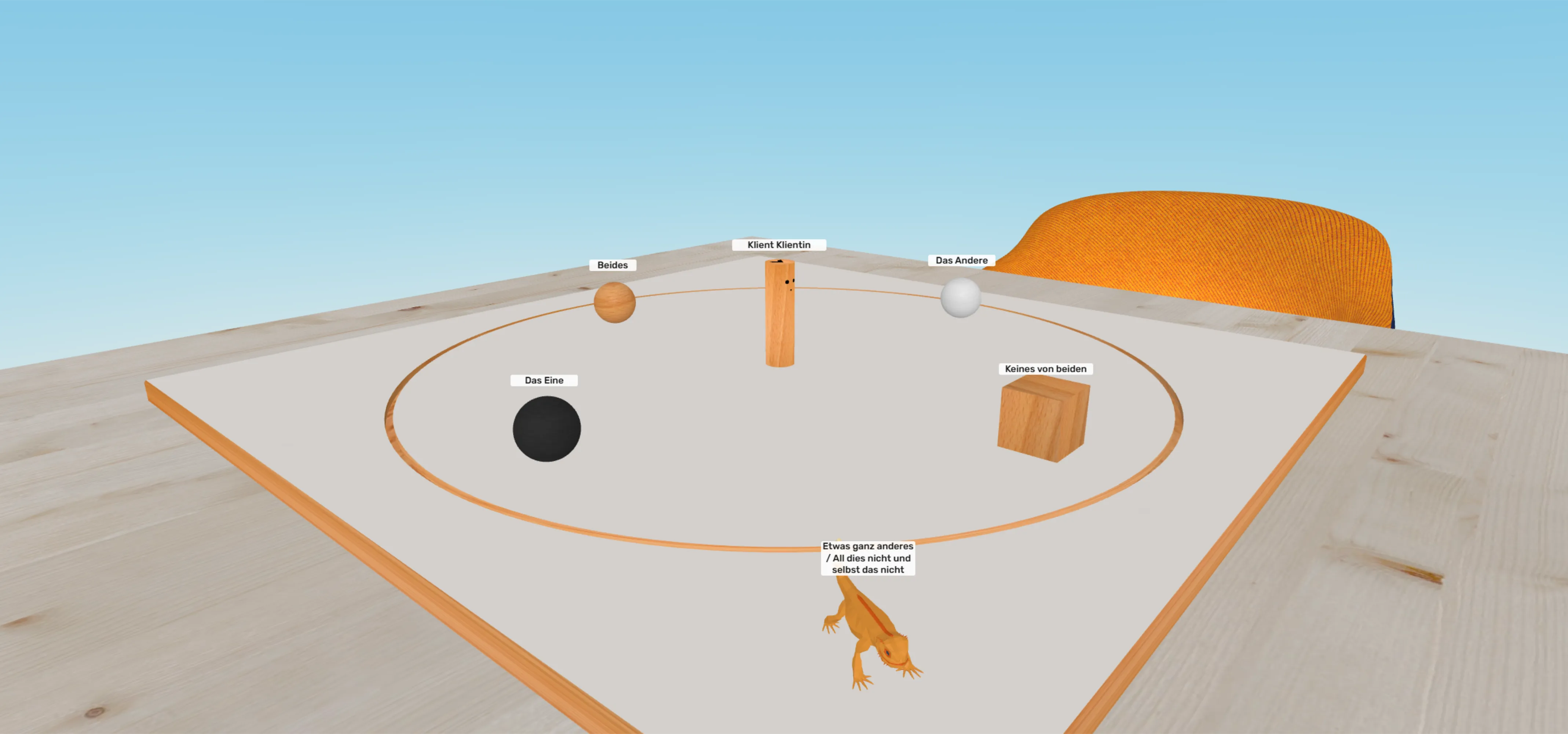
The tetralemma originally comes from Indian logic and was later transferred into systemic consulting and coaching contexts. Instead of contrasting just two options, it expands the space to five possible positions:
1. The one
The first option, for example a decision that is already on the table.
2. The other
The apparent alternative to the first possibility.
3. Both
The question of whether and how elements of both options can be combined.
4. Neither
Deliberate distance from both possibilities. Sometimes exactly this step brings new clarity.
5. Something else entirely
A space for the not-yet-thought. Surprising solutions can emerge here that previously lay outside the field of vision.
This expansion of the thinking space often brings relief. Clients do not have to commit immediately; they can explore different positions.
Spatial experience in coachingspace
Systemic methods live on topics being not only discussed but also experienced. coachingspace provides a virtual room for this, in which figures, positions and perspectives can be arranged freely.
For tetralemma work, the constellation board is especially suitable. The five positions can be laid out in the room here. The client then positions a figure for themselves and moves mentally or symbolically from field to field.
This spatial representation creates new perceptions:
How does closeness to one option feel?
What distance opens up to another?
What changes when the perspective shifts?
In coachingspace, changes of perspective can also be used: the client can take the first-person view of a figure and look at the room from that standpoint. This makes tangible how a decision feels from different angles.
A possible sequence in coaching
One possible way to begin could look like this:
First, the two familiar options are formulated together with the client: “the one” and “the other”. Then the remaining fields are added. All five positions receive a place in the room.
The client is invited to place their figure on the different positions one after another and to describe:
What becomes visible here?
Which thoughts come up?
Which feelings can be perceived?
Often the most exciting moment comes when the position “something else entirely” is entered. New ideas frequently emerge here that were not part of the conversation before.
Why the tetralemma works well in the digital space
Digital coaching rooms open up possibilities that go beyond classic conversation settings. coachingspace translates established systemic methods into a spatial, interactive environment.
Clients can see their topics, move them and view them from different perspectives. That makes complex decision processes more tangible and supports deeper reflection.
Methods like the tetralemma in particular benefit from this, because they work strongly with space, position and changes of perspective.
Conclusion
The tetralemma invites you not to narrow decisions down prematurely. Instead, a space emerges in which new possibilities become visible.
With coachingspace, this method can be experienced in the virtual room. Figures, perspectives and positions create a vivid basis for reflection and open new ways for clients to look at their situation.
This is how a seeming “either-or” becomes a rich decision space.