The Constellation Board with Axes: Mapping Four-Quadrant Models and Scales Online
Four-quadrant models are part of the standard toolkit in consulting, coaching and team development. Most of the time they live on a slide or a flipchart, someone explains the two dimensions, and the group nods. What rarely happens: that the people involved actually step into the model and look around from there. With the new constellation board with axes in coachingspace, that is exactly what you can do, in the virtual 3D room and with all the figures you know from constellation work.
What is new about the constellation board with axes?
Two new boards have been added. Both have an X and a Y axis, the second one additionally has a system boundary. They are available alongside the millimeter-accurate digital version of the original board by Ludewig and Wilken, the round board and the other variants to choose from.
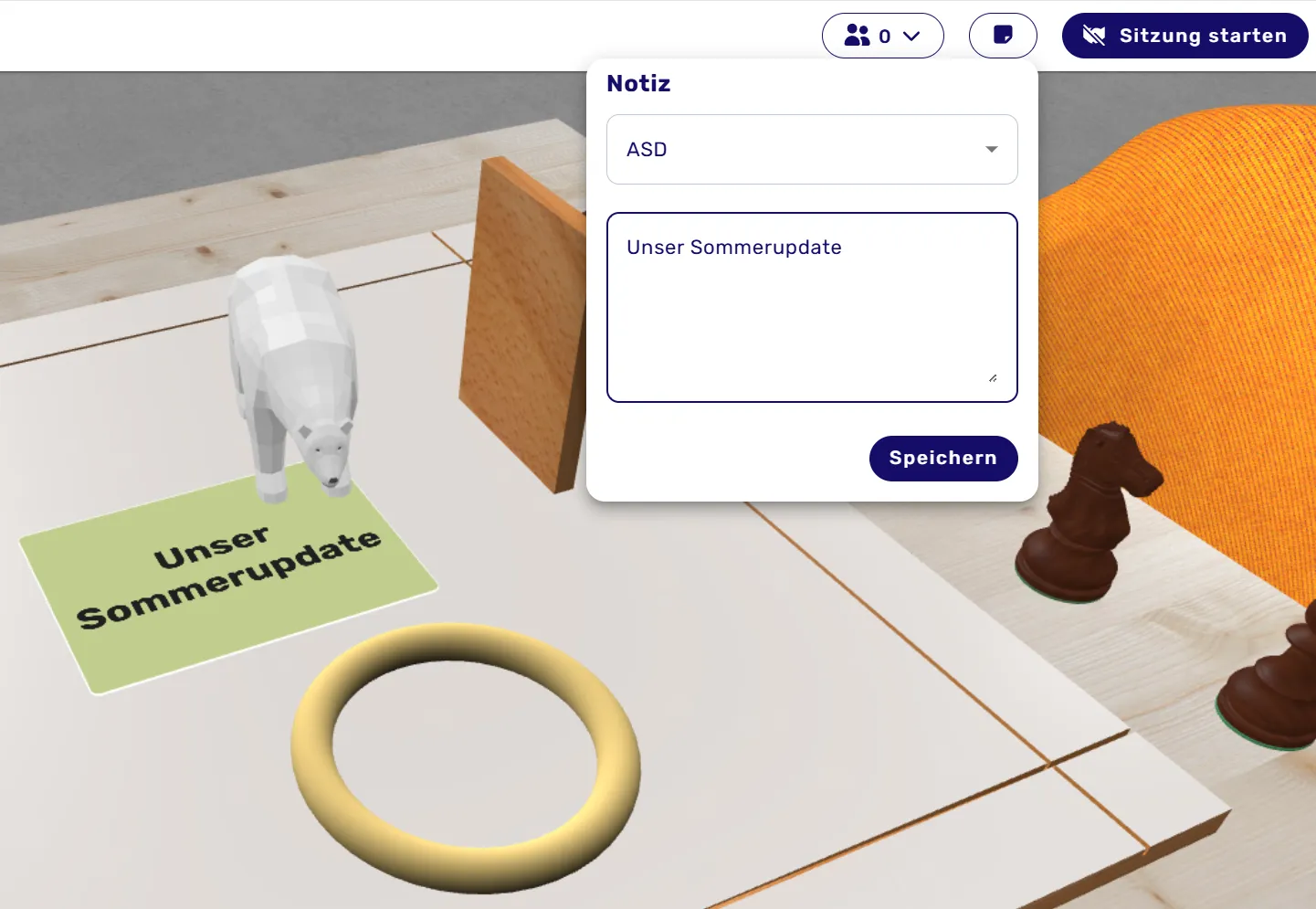
The key point: the axes carry no labels. That is not an oversight, it is the whole idea. You place moderation cards at the ends and label them yourself. What you get is an empty four-quadrant grid that takes any model working with two dimensions, and equally any question you open up together with your client.
Which models can you put on the axes?
The obvious use: you lay out a model you already work with, and the participants position themselves within it.
Riemann-Thomann: closeness and distance on one axis, continuity and change on the other
Task and relationship orientation: a classic for leadership and culture questions
Importance and urgency: when priorities and the criteria behind them are the topic
Influence and interest: the stakeholder map before a change project
Ability and willingness: in people development and leadership coaching
Effort and impact: when a long list of measures needs sorting
The difference to a diagram is that nobody puts a checkmark somewhere. Instead, people place a figure that has a viewing direction and stands in relation to the other figures. Anyone standing in the same corner as two colleagues sees it immediately.
How do you build your own axes out of the conversation?
It gets more interesting when the axes do not come from a textbook but from the session itself. In almost every conversation, two fields of tension come up that can be named, for example "a lot of responsibility" against "little responsibility" and "visible" against "invisible". Or "tasks that give me energy" against "tasks that drain energy" and "what others expect of me" against "what I want myself".
Ideally your client labels the cards themselves. Formulating the poles is already work on the topic, and afterwards the terms fit precisely, because they are their own.
How do you use the axes as a scale from 0 to 10?
The axes do not have to carry two opposites, they can also be two scales. That lets you ask the classic scaling question from solution-focused work in two dimensions: how satisfied am I with the result, and how satisfied with the path towards it? How high is the importance, how high the confidence?
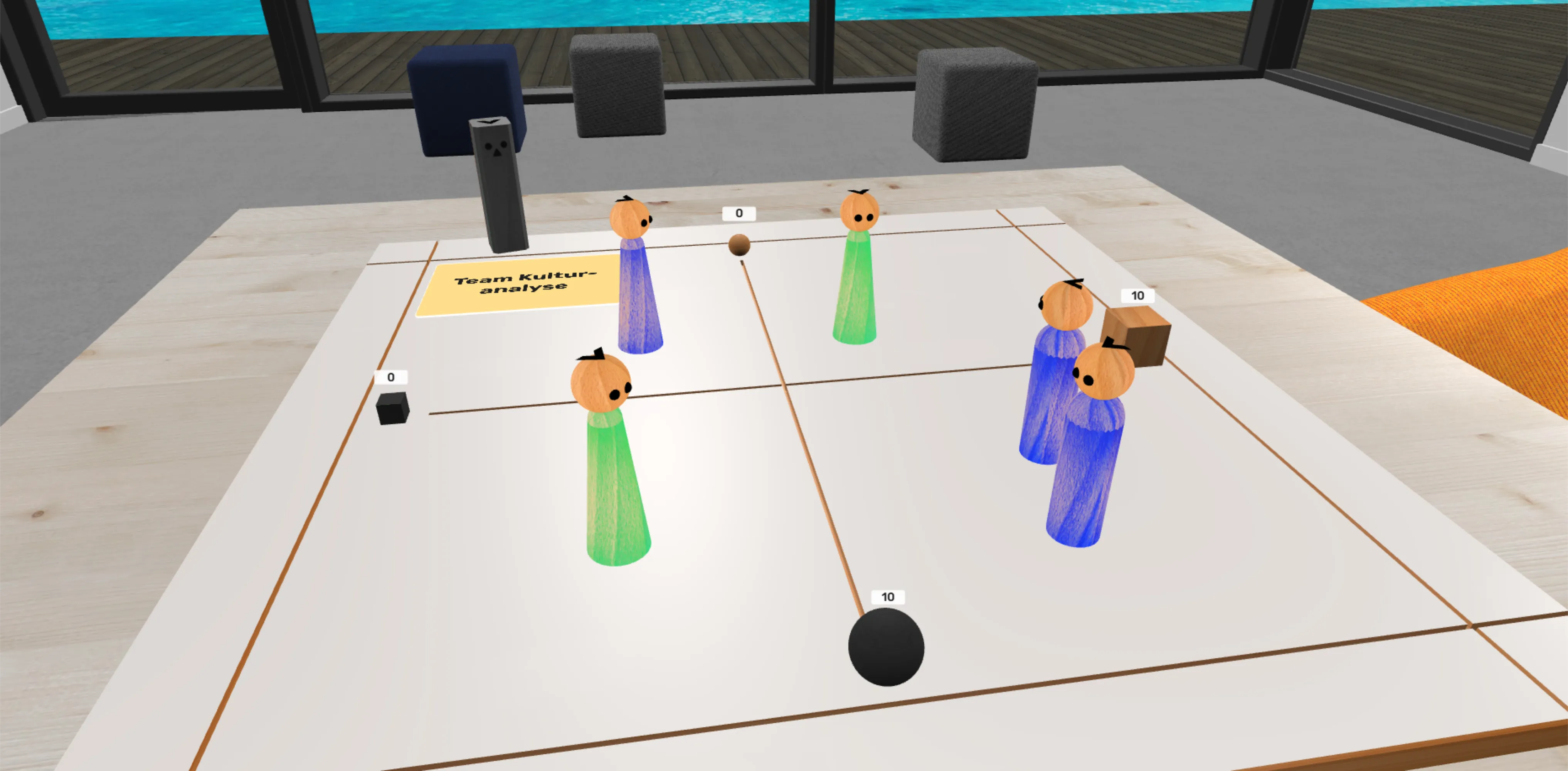
One practical trick: lay out the values with objects rather than with cards. Boxes from 0 to 10 on one axis, balls from 0 to 10 on the other, sized to match the value. The reason is the third dimension. In the virtual room you rotate the camera, and labeled cards are hard to read from the opposite side. The shape, on the other hand, stays unambiguous. Whoever sees a ball knows which axis it belongs to, even from within the inner perspective.
Placing the current position and the desired position side by side
As soon as the first figure is placed, it can be duplicated. The copy moves to where your client would like to stand. Both positions are visible at the same time, and between them lies a distance you can talk about: How far is that? Which axis would have to move first? What happens to the other figures if this one shifts?
For goal-oriented work this is the real strength of the axes, because the movement gains a direction instead of just being "better" or "more".
Comparing self-image and perceived image
Two figures for the same person, one for their own assessment and one for where your client believes the team or their manager sees them. The gap between the two is often the topic of the next half hour.
In team sessions you can turn this around: first everyone positions themselves, then the team positions the same person again. This requires trust in the group, but it produces material a conversation alone cannot reach.
What does the inner perspective add on the axes?
The step that carries the whole method is the inner perspective. You can enter a figure and see the room from its position, look around and turn the viewing direction. Anyone looking out from a figure standing far out in one corner genuinely sees the others far away. That is something other than being told about it, and it is the moment where a sorting exercise turns into a constellation.
Case study: Riemann-Thomann as a team constellation
The case I use this board for most often is Riemann-Thomann in team development. The model describes four basic strivings people move between, and it explicitly describes them as tendencies in a given situation, not as personality types. For work in a team that is the decisive precondition, because otherwise labels appear very quickly.
This is how I go about it:
The four poles are placed at the ends of the axes with moderation cards, closeness and distance horizontally, continuity and change vertically. Before anyone places a figure, we clarify together what those terms actually mean for this team.
Everyone chooses a figure and positions themselves, at first without a name tag. The names can be shown later if the team wants that.
We look at the picture together. Where does it cluster, where does someone stand alone, which quadrants are empty?
Only then do we assign names, and voluntarily. Whoever wants to tell the others why their figure stands there, tells them.
Finally we switch into the inner perspective and look out from individual figures.
What becomes visible is the diversity within the team. Almost always the figures stand further apart than the participants expected. This heterogeneity is first of all a resource, because a team occupying all four quadrants can handle more situations than one crowded into a single corner. At the same time the picture explains some of the friction: someone who needs a lot of change experiences continuity as standstill, and someone who needs continuity experiences change as unrest. Both are legitimate, and both may be named.
One note on choosing the board: for Riemann-Thomann, use the board without boundaries. Everyone in the team belongs, they simply stand in different places.
What is the system boundary on the second board for?
The second new board has a system boundary in addition to the axes. That allows a question the axes alone cannot ask: who actually belongs?
An example from organizational consulting. A team stands on the board, positioned by task and relationship orientation. Outside the boundary stands a figure for the former boss. He shaped how this team deals with mistakes, how much control is considered normal and whether people say what they think. He left long ago, and every new colleague still learns his rules without ever having met him.
As long as he is not on the board, the team talks about a climate that supposedly nobody created. Once he stands there, outside the boundary and visible nonetheless, questions become possible. What does he still have a say in? What have we adopted from him without ever choosing it? What do we keep because it is good, and what only because it has always been that way?
A boundary does not tell you who has influence. It tells you who belongs. Those are not the same thing, and that is precisely the difference this board makes visible. It does not have to be a former boss. It can be the founder, the colleague who left after a conflict, in family work the late grandfather or an ex-partner. Absent does not mean without effect. Here too the inner perspective is the key, because from a figure inside the team you can see who stands close, who is far away and who has a say from outside the boundary.
How to set up the constellation board with axes
When creating the constellation board method, you choose the name, figure design, board design and room environment as usual. You will find the two new boards among the board designs. After that you label the axes with moderation cards and decide whether your clients may place figures themselves.
Two practical notes for team sessions: take a snapshot as soon as the first picture is complete, so that at the end you have both states side by side. And plan time for the inner perspective, at least ten minutes per person who steps in. A change of perspective needs calm, otherwise it stays at the level of looking.
Frequently asked questions about the constellation board with axes
Do I need a specific model for the axes?
No. The axes are unlabeled, you define the poles yourself with moderation cards. Any model with two dimensions works, and dimensions taken from the conversation work just as well.
Can I also use the axes as a scale?
Yes. Instead of two opposites, lay out values from 0 to 10, ideally with objects rather than cards, so the direction stays recognizable even when the camera is rotated.
What is the difference between the two new boards?
Both have the same axes. The second one additionally has a system boundary and is therefore suited to questions of belonging. When everyone involved obviously belongs, use the board without a boundary.
Does this also work with larger teams?
Yes, although group size limits anonymity. In a team of five it is usually clear very quickly who stands where. Address that beforehand instead of promising an anonymity that does not exist in practice.
Can clients move the figures themselves?
Yes. You work in the same room at the same time, and every person can place, name and move figures. For phases in which only you should be working, editing can be locked temporarily.
Are the axes also suitable for one-to-one coaching?
Yes. Instead of team members, your client positions their roles, their options or their tasks. Scaling work, for example importance against confidence, also maps well onto the axes.
Does the board with axes cost extra?
No. Both boards are part of the constellation board method and are included in your existing subscription.
Try it now
Both new boards are available in every account. You will find them among the board designs when creating a new method, and you can use them in your next session without installing anything.
Not working with coachingspace yet? Then get to know the platform for online coaching, consulting and supervision in our free live demo. In 90 minutes we guide you through the virtual coaching room, show the constellation board with axes in a real constellation, including the inner perspective, and answer your questions. All methods run GDPR-compliant on servers in Germany.