Introduction
VAT (Umsatzsteuer) is a tedious but crucial topic for many coaches. Since 1 January 2025, the legal situation has changed considerably, bringing new opportunities but also new requirements. For coaches working systemically in particular, the question arises: When is coaching subject to VAT, and when is it exempt? This article helps you understand the new rules and apply them correctly to your practice.
1. Not all coaching is the same: what matters is how it is designed
For VAT purposes, the label does not count, but what you actually do:
Advisory coaching: focus on individual problem solving, reflection and decision-making → as a rule subject to VAT
Teaching coaching: targeted teaching of skills, knowledge or professional competencies → potentially VAT-exempt
It depends on whether your coaching is more like consulting or more like teaching.
2. What specifically changed in 2025?
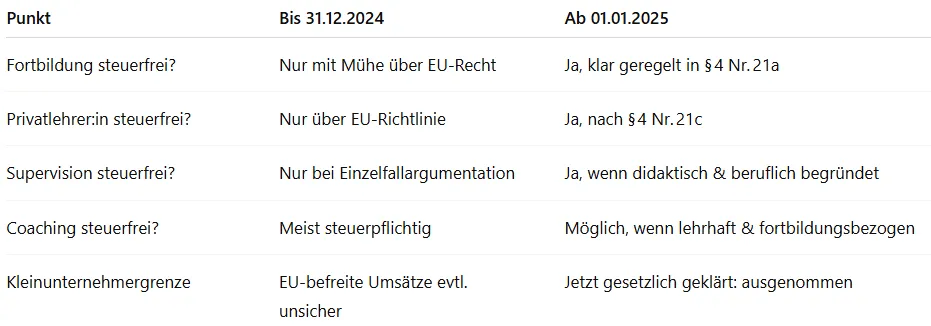
✅ "Further training" (Fortbildung) is now officially VAT-exempt
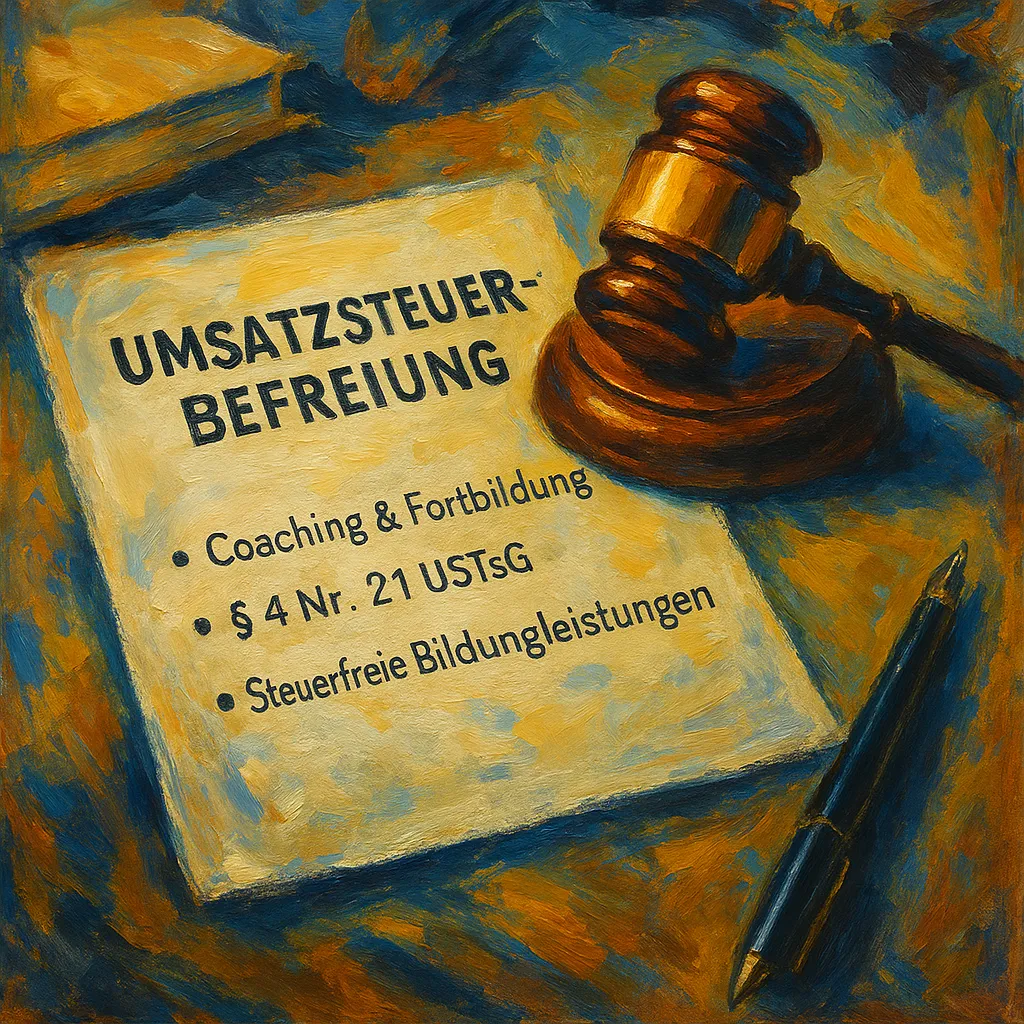
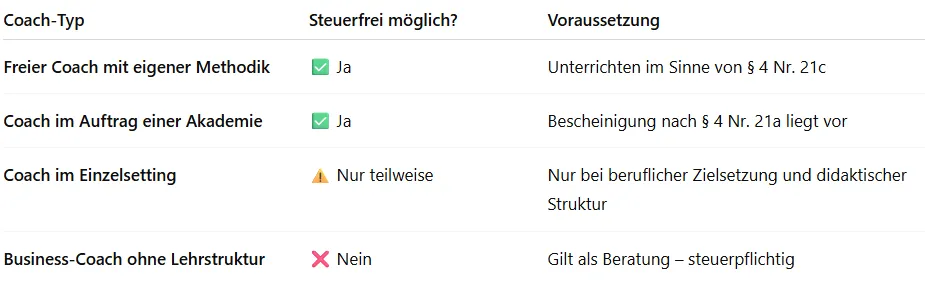
Since 1 January 2025, Section 4 No. 21 of the German VAT Act (§ 4 Nr. 21 UStG) explicitly includes further training as a VAT-exempt educational service. Coaching that is clearly geared towards professional development can therefore be VAT-exempt, if:
you act as a vocational training institution (berufsbildende Einrichtung) and
you hold a certificate from the competent state authority (Bescheinigung der Landesbehörde) under § 4 Nr. 21a.
✅ Coaches who teach privately can now rely on German law
If you teach independently and on your own responsibility (without an institutional provider), you can deliver your coaching as VAT-exempt teaching-like services (unterrichtsähnliche Leistungen) under § 4 Nr. 21c UStG. Previously, this was only possible on the basis of EU law.
3. When is coaching VAT-exempt? The 3-step logic
Coaching can be VAT-exempt if …
… it serves professional qualification
→ e.g. leadership development, communication skills, stress management at work… it is didactically structured
→ e.g. learning objectives, modules, exercises, transfer phases, use of materials… you deliver it as "teaching" (not consulting)
→ e.g. based on a curriculum, with your own pedagogical methodology
4. What applies to one-to-one settings?
One-to-one coaching is particularly tricky from a tax perspective:
Consulting or an on-demand "coaching conversation"? → subject to VAT
Didactically embedded one-to-one coaching within a training program? → can be VAT-exempt
Coaching commissioned by an employer (e.g. supervision, team development)? → exemption possible if a professional connection can be demonstrated
Important: Document your concept. That way you can make your teaching intent clear to the tax office (Finanzamt).
5. Invoicing coaching without VAT: here is how
6. Conclusion: your coaching, your responsibility
The new rules from 2025 bring more clarity and more opportunities. If, as a systemic coach, you work in a structured way, focus on learning objectives and see yourself as a teacher, you can save VAT and act on a legally sound basis.
What matters: Design your offer consciously, not only in terms of content but also in terms of tax. And: documentation is everything.
Read the full article (in German) here: