Guest post: This post was written by Anne Jansson and reflects her personal view. The author alone is responsible for its content. Coachingspace GmbH did not contribute to the content and does not adopt it as its own.
A 10-visit swimming pool pass describes fairly precisely what you get: 10 visits to the pool. But perhaps you go swimming because you want a beautiful back. Then the pass is one possible way to something that matters to you personally.
The same view is worthwhile for a coaching offer. “5 sessions of 60 minutes each” describes the time involved. For a prospective client, it leaves open which concern you will support them with, what you will work towards together and how the collaboration will work.
If you want to extend your in-person coaching online, you can clarify these questions at the same time. The result is an offer that makes the value of your work understandable and gives you a basis for your planning.
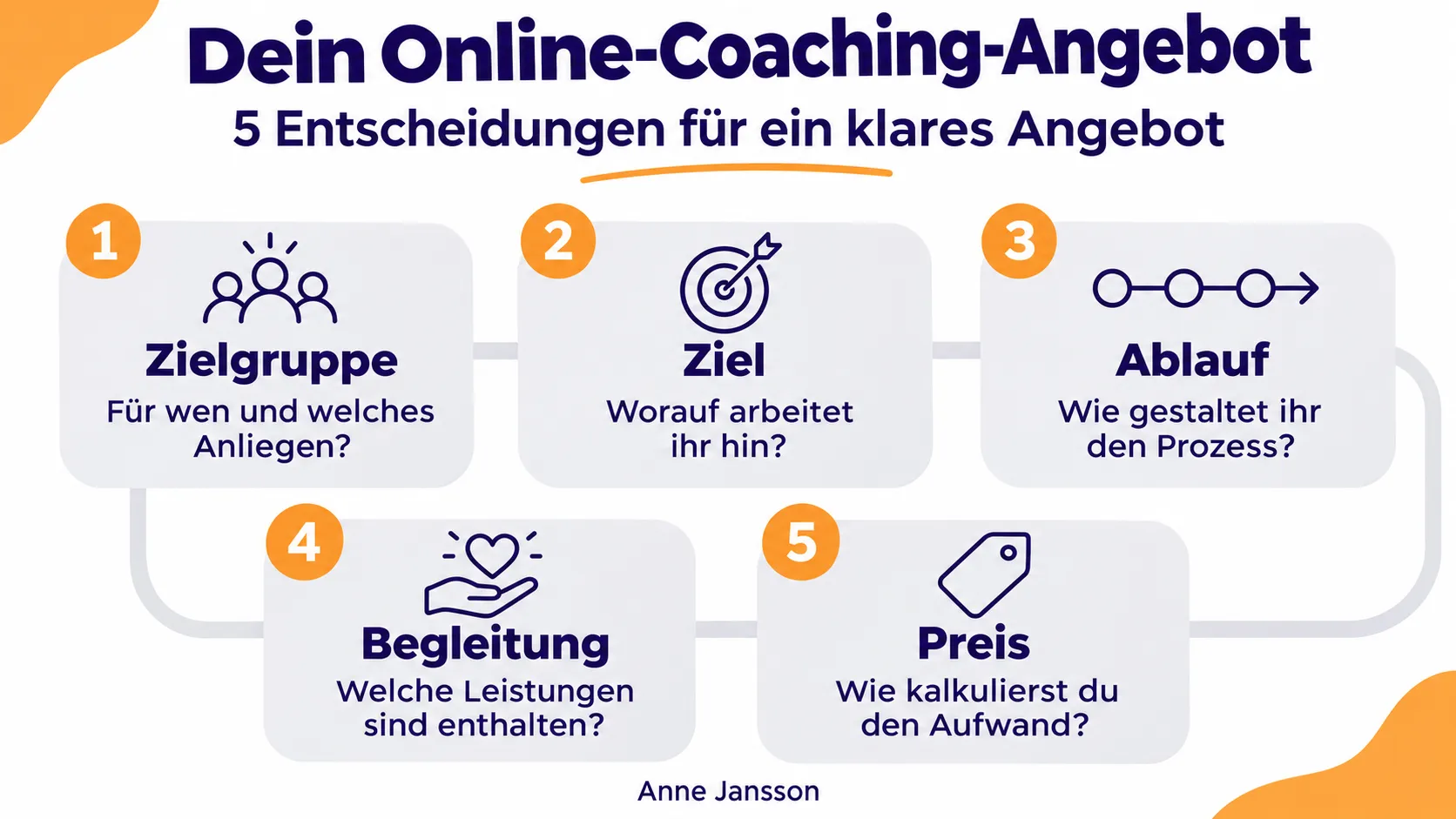
Graphic 1: Your online coaching offer in 5 decisions
1. Clarify who your online coaching is for
Your experience from working in person is a good starting point for developing your offer.
Look at the concerns your current clients come to you with. On which topics can you offer particularly good support with your qualifications and way of working? Which of them do you want to and can you support online?
You are allowed to be specific here. “Coaching for personal and professional development” leaves room for very different expectations. Support with a career decision already describes more clearly when someone might use your offer.
You do not have to redevelop your entire positioning for this. First check whether a prospective client can answer these questions:
Am I in the right place with my concern?
What exactly does this coach help me with?
What can I expect from working together?
What prerequisites should I bring?
Also consider which of your working methods you can use online, where you need to make adjustments and when you would recommend an in-person appointment. Perhaps a combination of both formats suits your work.
2. Offer single sessions and coaching packages
My recommendation is to keep single sessions in your range and to add around 2 well-thought-out coaching packages.
A single appointment can be right when someone wants to work on a clearly defined question. An initial joint clarification can also help to assess the need for further support.
With other concerns, it already becomes clear in the first conversation that several appointments make sense. Perhaps the client needs time to try something out in everyday life and then review it with you. Perhaps several related decisions are coming up.
For such situations, you can recommend a package and give professional reasons why you are proposing this framework. Explain what you would work on and why you are planning time between the sessions.
You and your client choose the right offer together. Also discuss how you will proceed if the concern changes during the coaching.
Coaching packages are just as suitable for in-person work. The move to the online format is a good opportunity to review your own offer structure.
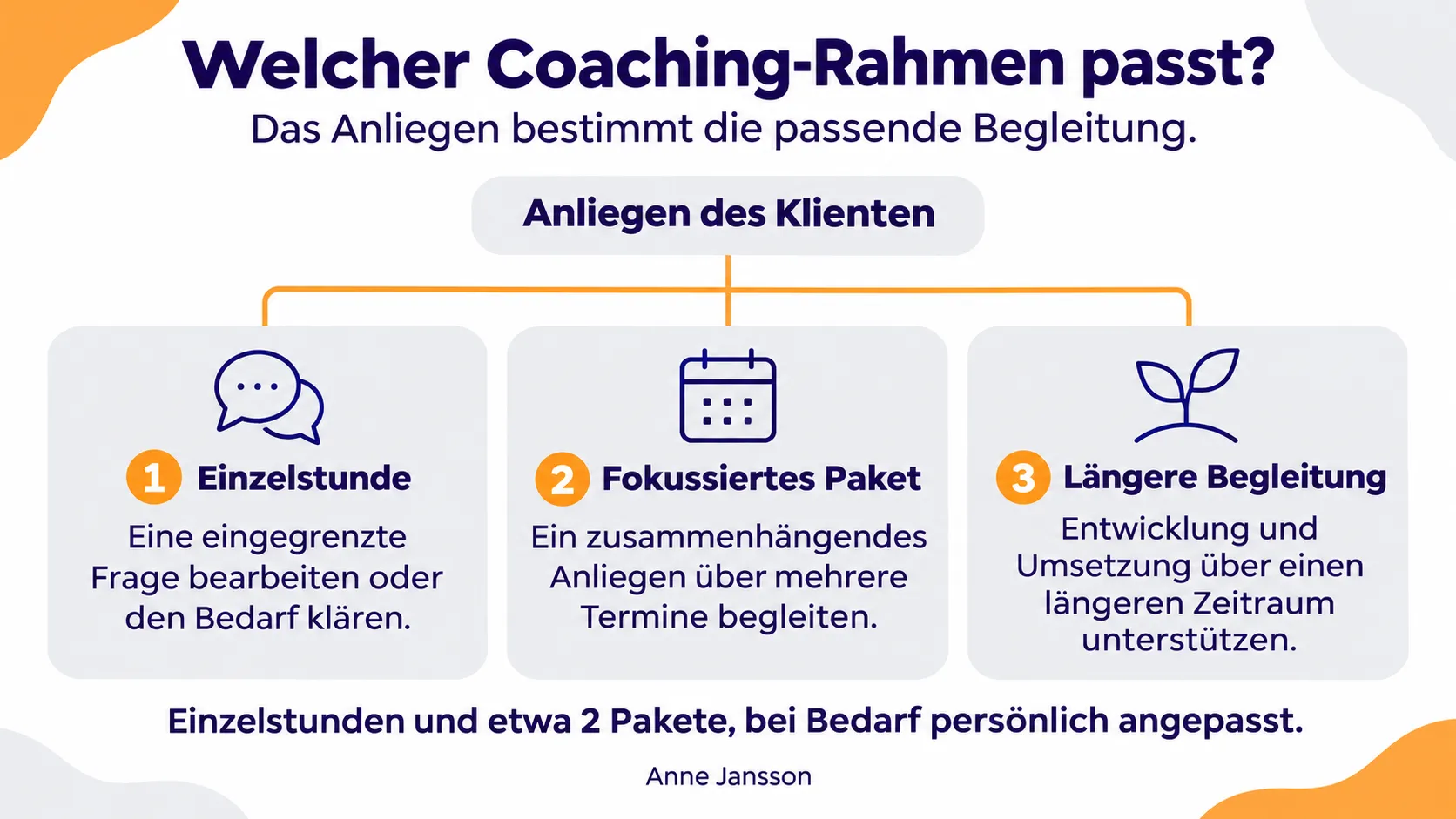
Graphic 2: Single session, focused package and longer-term support
3. Develop your packages from the concern and the goal
A coaching package should make clear which development you are aiming for together and how you support the client along the way.
Start with the concern and describe a realistic goal for the collaboration. From this, you derive the possible process and the right scope.
The goal could be, for example, to clarify one’s own decision criteria, examine career options and prepare a next step. Which decision the client makes remains up to them.
In this way, you name the intended result while preserving the openness of the coaching process.
How 2 packages can differ
As a fictitious example, let’s take a coach who supports people with career decisions. Their two packages could be structured like this:
Clarifying a career decision
Suitable concern: A specific career decision is coming up.
Goal of the collaboration: Examine decision criteria and options, work out a well-founded next step.
Possible framework: 4 online sessions over about 8 weeks.
Between appointments: Agreed reflection questions to prepare for the next session.
Supporting a career reorientation
Suitable concern: A career change is to be prepared and tested over a longer period.
Goal of the collaboration: Develop a direction, implement first steps and evaluate the experience.
Possible framework: 6 online sessions over about 3 months.
Between appointments: Agreed reflection questions and limited personal feedback on the experience of putting things into practice.
The figures are examples. In your work, you derive the scope and time frame from the professional need and your experience.
The two offers differ in their task and in the depth of support. This helps prospective clients judge which framework suits their concern.
If needed, you can adapt such packages individually. Perhaps a client needs longer intervals between appointments or an additional session. Record the agreed adjustment and its price clearly.
4. Describe the support between sessions
Online, you can provide materials before an appointment, enable reflection between sessions or offer personal feedback. Decide deliberately which services are part of your coaching.
If, for example, you use a digital journal, the client can record observations there. You can pick these up in the next appointment. If you also agree that you will read and comment on entries in advance, this creates additional support effort.
It should be clear to the client:
Which tasks or materials will they receive?
Do they work on them on their own or do they get personal feedback?
Through which channel can they get in touch?
To what extent and within what time do you reply?
Which topics will be discussed in the next coaching appointment?
“Personal support throughout the entire term” leaves these questions open. A specific description creates more reliable expectations.
An example wording for an offer would be:
Between sessions, you can send me a short written update on your agreed implementation step once a week. You will receive a reply within 2 working days. We will work on more extensive topics in the next coaching appointment.
Whether this scope suits your work is up to you. You can just as well offer a package with sessions and independent reflection. Every additional service needs a professional purpose and a place in your planning.
5. Design the start of the online coaching
Before the first appointment, a client should know how the coaching works technically and organizationally.
Briefly explain which device and which access they need. Discuss how you create a confidential setting with as few interruptions as possible and what happens if the connection drops. If you work with digital materials, show them the functions they need.
Also check which of your methods you want to use online. Perhaps you work on a visualization together or come back to an earlier diagram in the next appointment.
Benjamin Lambeck explains the methodological design of digital coaching rooms in more detail in his article “Online Coaching Is More Than Zoom: Rethinking Digital Counseling”.
For your offer, you choose from these the services that suit your support. An available feature does not oblige you to include it in every package.
6. Calculate the total effort of your coaching package
Include all the working time you expect to need for the package.
A simple, fictitious calculation example:
4 coaching sessions of 60 minutes each: 4 hours
Preparation and follow-up, 15 minutes per session in total: 1 hour
3 personal feedback messages of 10 minutes each: 30 minutes
Organization and wrap-up: 30 minutes
Total time required: 6 hours
For this package, you should calculate 6 working hours. On top of that come a proportionate share of your operating costs and the working time for the other tasks of your self-employment.
Especially with a new offer, it is worth recording the time you actually need. This shows you whether your assumptions are correct.
When deciding on the price, you also take into account your professional expertise, the responsibility and the scope of the support. The time calculation helps you assess the economic consequences of your decision.
In my view, a package price does not need an automatic volume discount. Consider what the overall offer includes and what price you can stand behind.
Nor is the fact that the coaching takes place online a sufficient reason to lower the price across the board. Your qualifications and your personal work are still part of the service.
An example from my work
My client Michael is a spiritual healer. He used to offer individual sessions in person. Today he sells support packages online. With this development he earns considerably more and is happier and more satisfied with his work. His clients are more satisfied too.
For Michael, the switch to the online format and a change in how he designs his offer came together. That is why, for a development like this, I would always look at both: How do you want to work, and which offer suits your clients’ concerns?
7. Explain your offer so that prospective clients can assess it
Once the framework is in place, you can write your offer description. Connect the concern, the intended goal and the services included.
For our fictitious example, the opening could read like this:
This online coaching is for people who want to clarify a specific career decision. In 4 sessions over about 8 weeks, we look at your current situation, your decision criteria and possible options. The goal is for you to work out a well-founded next step. Between appointments, you will receive agreed reflection questions, and we will pick up their results in the next session.
After that come the practical details: length of the sessions, scheduling, technical requirements, price and payment method.
Also describe the limits of the offer. These include, for example, services you do not offer professionally and support that goes beyond the agreed scope.
If companies are the commissioning party, also clarify which goals and feedback are agreed with them. Discuss clearly how confidentiality towards the client is maintained.
Checking the legal framework as well
Have the contract terms, data protection questions and, where applicable, consumer information that apply to your offer checked by an expert.
For offers that combine personal support with knowledge transfer and learning materials, the German Distance Learning Protection Act (Fernunterrichtsschutzgesetz) may also become relevant. How it applies depends on the specific range of services. The Staatliche Zentralstelle für Fernunterricht explains the requirements and the significance of the contractual focus in its questions and answers for providers (in German).
8. Test your offer and develop it further based on practice
You can start with a clearly described offer and test it with a manageable number of clients.
Then check whether your clients understood the scope before booking. Compare the planned time with the actual time spent. Look at whether the intervals between appointments worked and which services were used.
The course of the coaching is also revealing: where was more time needed? What could be worked on well between sessions? Which expectations did you still have to clarify during the coaching?
With these experiences, you can develop your packages further in a targeted way.
To start with, I recommend single sessions and around 2 packages whose use you can explain clearly. Start with a concern you know well from your previous work. Describe the goal, the possible process and your contribution to it. Then check whether the scope and price also work for you.
This way, prospective clients can see what kind of support they will get from you. And you yourself know more precisely what service you are committing to and how much work it involves.
About the author
Anne Jansson is a business mathematician, business mentor and founder of the Health Business Academy. She supports coaches and therapists with positioning, offer development and client acquisition.