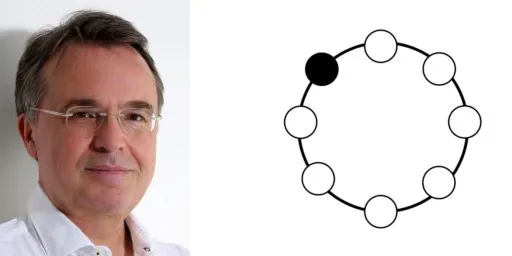
From clients' painted and sketched images, basic forms were extracted and condensed into a language of signs. The individual signs are captured on a total of 37 focus cards, from which clients can make a selection in various ways. The abstract signs stand for prototypical basic human experiences. They are also ambiguous, allowing clients to picture their very personal experience in a playful way and then explain it in conversation. The card set has been in use for several years in both coaching and psychotherapy.
Avoidance and approach cards
"Please choose one card that corresponds to a state or feeling you want to avoid. And please also choose a card that appeals to you positively, standing for a desired state or feeling."
The second card is placed to the right of the first. A conversation develops about the negative and the positive pole, and thus also about the obstacle that makes the transition to the desired goal difficult.
Occasionally it is revealing to swap the "negative" card with the "positive" one. What was to be avoided suddenly becomes a goal. Cognitive behavioral therapy teaches us that people often avoid a state that actually promises development, but which is not realized out of fear of failure. It is exactly this insight that the playful swapping of the cards can convey. It often becomes clear that clients have had unpleasant experiences with this negative pole in the past, developed fears of it, and therefore let this essential part of their personality wither, like a rarely trained muscle. Once it lies in the "goal position" with the corresponding card, an incentive can arise to engage with it once more.
The third card
Psychotherapy and coaching aim substantially at insights into the causes of a problem. But it seems equally important to me that new options for action or new perspectives are developed. According to Aristotle, the main characteristic of an action is that it has a beginning, a middle and an end. In the middle, the transition from A to B takes place. It is the zone of change, whether through action or a change of perspective.
This transition can be simulated by choosing a third card: "Now please pick a third card that could help you get from A to B, and place it between the two cards already on the table. Tell me more about it." Alternatively, clients can illustrate the path from the negative to the positive pole with a small sketch.
Five cards tell the whole story
Beginning, middle and end mark only the simplest scaffold of a story, a so-called "minimal story" (Gerald Prince). If you want to get to know more aspects of a change process, you need further stations (cards); a selection of five cards in total has proven most fruitful.
"Please choose five cards that have something to do with your problem, your conflict or your concern." A conversation develops in which the clients explain different aspects of their topic with the help of the selected cards. In the next step, they are asked to arrange the chosen cards in an order that leads from "problem" to "solution". Although, per the original selection prompt, these are all "problem cards", clients are astonishingly almost always able to lay out a solution story from this selection. The corresponding insight can be anchored further in the next step by asking the clients to tell a small story with the cards lying in a row. It begins with the first card like a fairy tale: "Once upon a time there was a young man, a department head, a working mother…".
Five cards and a picture
If you want to get a first overview of a client's problem or conflict, it often helps enormously to encourage painting a picture, for example with the prompt: "Try to depict your current state or situation in an image." In this so-called initial image, the problem is often captured very concisely. But it also appears baked in, seemingly unsolvable. In my seminars I teach various art-therapy interventions to set this frozen problem image in motion again and lead it towards a solution. One intervention is working with the focus cards. With the same prompt as above, I have the clients choose five cards that relate in some way to this painted problem or conflict. Again, a "story is laid", but one that includes the painted image. It is up to the clients whether the image lies at the beginning or somewhere between the selected cards.
The random card
It happens again and again that clients develop solutions for their problem in therapy or coaching, and then meet an entirely different challenge in everyday life for which their plan no longer seems to fit. This unknown situation can be simulated with a random card.
"Your five selected cards tell a beautiful solution story. But in life, things keep happening that are not really predictable. Draw another card blindly from the deck and place it at the end of the row. Now tell your story again and imagine that 'this' (the random card) happens. How do you react? Continue the story."